
★ Overview
ONI
Oni (鬼), which translated means Evil or Demon, is one of the more mysterious creatures you can find in Japan. The word Oni comes from the word “On” (隠) which means something to hide or be hidden. These creatures are a representation of something evil or scary, and are bad spirits which tend to “hide” or “are hidden”.
Oni are a type of Japanese yokai, which means supernatural or strange creature.
Oni can be one of five different colors. Each color represents one of the five worldly desires from Buddhism.
The most popular color is red, and it is called Akaoni (赤鬼), which means “Red Oni” in English. The second famous color is blue, Aooni (青鬼), and this type tags along with the red type.
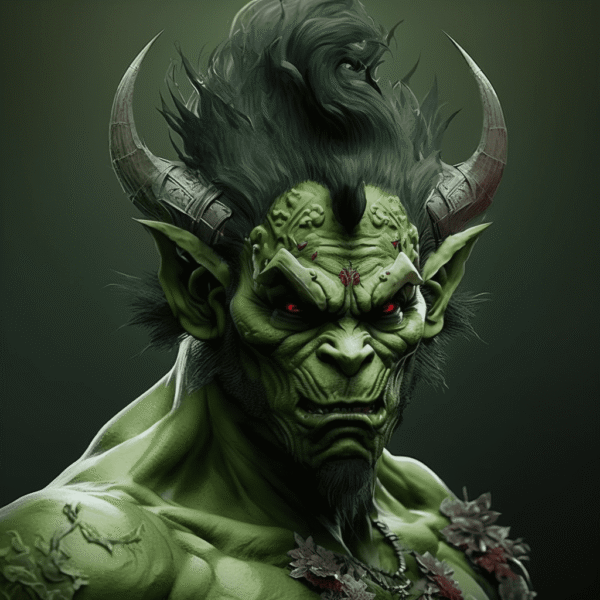
The remaining ones are yellow, green, and black. Each desire is listed below along with its corresponding color of Oni:
Five worldly desires / Gogai (五蓋)
Tonyoku (貪欲) lust – Red
Shinni (瞋恚) hatred, anger – Blue
Osa (悪作) regret, agitation – Yellow
Konjin (惛沈) laziness, sleep – Green
Gwakui (疑惑) doubt – Black
Origin & History
The origins of oni are rooted in Shinto and Buddhist beliefs, as well as in ancient Japanese legends and myths.
According to Shinto mythology, oni are born from the souls of wicked humans who are punished after death by being transformed into demonic beings. In Buddhist beliefs, oni are considered to be manifestations of negative human emotions such as anger, jealousy, and greed.
Originally, the term oni referred to invisible spirits or ghosts (from the Chinese character guǐ), but over centuries, they evolved into the solid, hulking brutes we recognize today. They serve a dual role: as the terrifying wardens of Jigoku (Buddhist Hell) who torture sinners under the command of King Enma, and as mountain-dwelling ogres that descend to terrorize human villages.
The earliest known depictions of oni can be traced back to ancient Japanese artwork from the 8th century, where they were often portrayed as fierce and menacing creatures with horns, fangs, and wild hair. Over time, oni became a common motif in Japanese art, literature, and theater, where they were often used as symbols of evil or as stock villains in folk tales and legends.
Today, oni continue to be a popular and iconic figure in Japanese culture, appearing in everything from manga and anime to video games and pop music. Despite their fearsome reputation, oni are also sometimes portrayed as comical or even lovable characters in modern media, and they remain a beloved and enduring part of Japanese folklore and mythology.
Powers & Abilities
- Superhuman Strength: An Oni can level buildings with a single swing of its club and crush boulders with its bare hands.
- Shapeshifting: Despite their size, they are masters of magical disguise, often appearing as beautiful women or wandering priests to lure unsuspecting travelers into a trap.
- Calamity Manipulation: They are said to be the source of natural disasters, including thunder, lightning, and the spread of infectious diseases.
- Regeneration: Some legends state that an Oni can reattach severed limbs unless they are scattered or destroyed before they touch the ground.
- Sorcery: High-ranking Oni are often powerful wizards, capable of casting curses and summoning dark spirits to do their bidding.
- Immortality: Oni are often depicted as being long-lived or even immortal, with some legends suggesting that they can only be killed by a special weapon or ritual.
Appearance
- The Rainbow of Hide: Most commonly depicted with vibrant red or blue skin, though they can also appear in green, black, or yellow.
- The Horns: They possess one or two ox-like horns sprouting from their heads. This, combined with their tiger-skin loincloths, is a reference to the "Ox-Tiger" direction (Northeast), the ominous "Demon Gate" (Kimon) from which misfortune is said to flow.
- The Grotesque Face: Exaggerated features including wide, staring eyes, a third eye (on occasion), and mouths full of tusk-like fangs.
- The Build: Towering giants, significantly taller and broader than the strongest human, with clawed hands and feet that sometimes have only three toes or fingers.
- The Signature Weapon: They are rarely seen without their Kanabō—a massive, hexagonal iron club studded with spikes. This is the source of the Japanese idiom "Oni ni kanabō" (An Oni with an iron club), meaning someone who is already strong becoming invincible.
- Oni are typically male, but there are also female Oni. Female Oni do not appear as frequently in traditional Japanese folklore, but have started to show up in various Japanese animation series. Female Oni are treated more as fantasy creatures which makes their impression less scary.