
★ Overview
BANSHEE
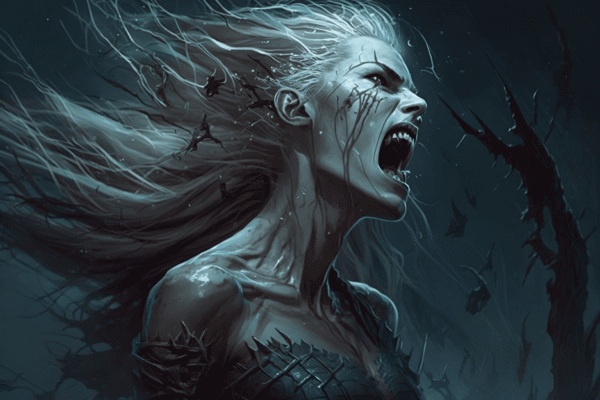
In Irish folklore, a banshee is a female spirit or fairy who is said to wail or shriek loudly to warn of an impending death. The word “banshee” comes from the Irish bean sidhe, meaning “woman of the fairy mound.”
The banshee’s eerie wail is said to be heard at night near the homes of those who are about to die. The wailing can be soft and mournful or loud and piercing, depending on the proximity of the death.
The belief in banshees is still prevalent in parts of Ireland and Scotland, and some families claim to have their own personal banshee who warns of impending deaths within the family.
-
The Banshee does not cause death — she announces it
-
Traditionally tied to specific Irish families, often of noble lineage
-
Her wail (keen) reflects human funerary practices, not malice
-
She is not a ghost, demon, or witch in original folklore
Origin & History
Deeply woven into the mist and sorrow of Irish folklore, the Banshee (from the Old Irish bean sídhe, meaning "woman of the fairy mound") is not a killer, but a mourner. She is a solitary fey spirit whose sole purpose is to prophesy death. Unlike the Hollywood version of a screaming hag that shatters glass, the traditional Banshee is a figure of tragic dignity. She is tethered to the "Five Great Families" of Ireland (the O'Gradys, O'Neills, O'Briens, O'Connors, and Kavanaghs), though legends say she eventually expanded her watch to any household with deep Celtic roots.
One theory suggests that the banshee may have originated from the old Celtic belief in a goddess known as the Morrigan. The Morrigan was a goddess of war and death who could take the form of a crow or a raven and was associated with fate and prophecy.
Another theory is that the banshee may have been inspired by the belief in ancestral spirits or ghosts. In Irish folklore, it was believed that the spirits of the dead could return to earth and interact with the living, and the banshee may have been seen as a kind of spirit messenger or guide.
Over time, the legend of the banshee became intertwined with the Christian belief in death and the afterlife, and the banshee was often seen as a kind of angel or supernatural being that warned of impending death or disaster.
Powers & Abilities
- The Keening (The Wail): Her voice is a supernatural force. It can be a low, rhythmic chant of mourning or a high-pitched, soul-shaking shriek that can be heard across miles, yet only by those destined to hear it.
- Precognition: She possesses an absolute knowledge of when a person’s thread of life is about to snap, often appearing days before the actual passing.
- Intangibility: As a spirit of the mounds, she can pass through walls and vanish into the mist instantly, making her impossible to capture or harm.
- Omens of the Silver Comb: If she leaves her comb behind, it is a deadly trap; any human who picks up a Banshee's comb is said to be haunted by misfortune or snatched away to the Otherworld.
Appearance
- The Three Faces: She is a shapeshifter who typically appears in one of three forms: a young, ethereal maiden with pale skin; a stately, middle-aged matron; or a wizened, terrifying crone.
- The Crimson Eyes: Her eyes are perpetually bloodshot and glowing red from centuries of continuous weeping for the dying.
- The Silver Hair: She is famously depicted with incredibly long, shimmering white or silver hair, which she is often seen brushing with a silver or golden comb.
- The Funereal Garb: She wears a long, flowing dress, usually described as grey or ghostly white, covered by a hooded cloak (a "braid") of the same color or a deep, mossy green.
- The Bare Feet: She is almost always barefoot, gliding silently over the dew-covered grass or hovering just inches above the ground.