
★ Overview
KAGE-ONNA
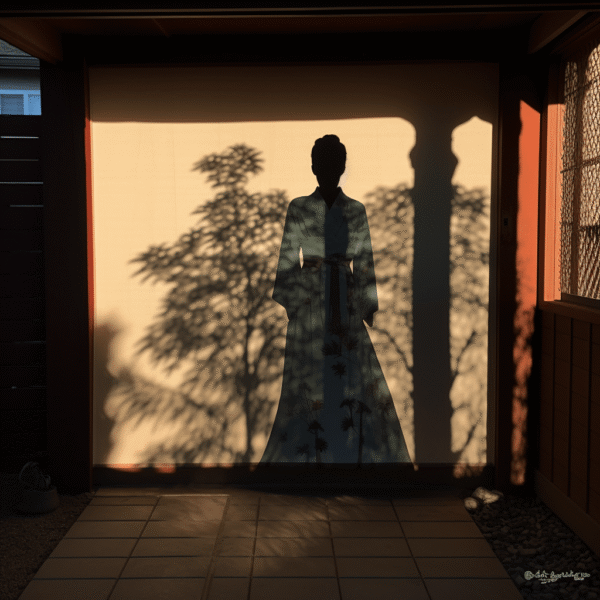
The Kage-onna (literally “Shadow Woman”) represents a haunting manifestation of voyeurism and domestic unease. Unlike many Yōkai that are physical monsters or vengeful spirits, the Kage-onna is a silent, optical haunting. She is almost never seen in the flesh; instead, she is a silhouette that appears on the shōji (sliding paper doors) of a house at night. She is the embodiment of the feeling of being watched, a phantom projection of a presence that shouldn’t be there.
She is often found in houses that are either haunted by deep sadness or occupied by a person dwelling on intense loneliness. She doesn’t speak, she doesn’t attack, and she doesn’t move objects. She simply is. While she is generally harmless, her presence is considered a terrible omen—a sign that the spiritual “health” of the home has decayed, or that the barriers between the living world and the shadow world have grown dangerously thin.
Origin & History
She is said to appear on moonless nights, when shadows are most potent. Her presence is often described as unsettling, with witnesses reporting the feeling of being watched or followed by an unseen presence. Some stories tell of her sudden appearances, flickering in and out of existence like a shadow cast by an elusive light source.In various accounts, the Kage-onna may appear to travelers or lone individuals on remote paths, causing them to question their perception of reality. She might beckon to them, leading them astray into the darkness, or she may simply vanish into thin air, leaving behind a sense of dread and confusion.
Powers & Abilities
- Optical Haunting: She can manifest on any translucent surface (paper, thin fabric, or frosted glass) as long as there is a light source behind it.
- Silent Stalking: She makes absolutely no noise—no footsteps, no breathing, and no rustle of silk. This makes her discovery particularly jarring when a resident turns around and sees her shadow already there.
- Psychological Decay: While she has no physical power, her constant presence can drive a person to madness or deep depression, as the inhabitant feels they are never truly alone in their own home.
Appearance
- The Silhouette: She appears as the crisp, dark shadow of a woman projected onto the paper of a shōji screen or a paper lantern. Even if there is no one between the light source and the screen, her shadow remains.
- The Traditional Form: She is usually depicted wearing a classical kimono with a high collar. Her silhouette often shows her holding a folding fan or adjusting a hairpin, frozen in a moment of domestic preparation.
- The Lack of Features: Because she is a shadow, she has no face, no eyes, and no color. She is a flat, two-dimensional void of darkness against the glowing white paper.
- The "Gargoyle" Variation: In some rarer accounts from the Edo period, the Kage-onna's shadow is said to have small, subtle horns—a hint that she might be a Hannya (a woman transformed into a demon by jealousy) reflecting her true nature through her shadow.
- The Ephemeral Nature: She vanishes the moment the shōji is opened. If a curious resident slides the door back to see who is casting the shadow, they will find only an empty, moonlit hallway.