★ Overview
CERBERUS
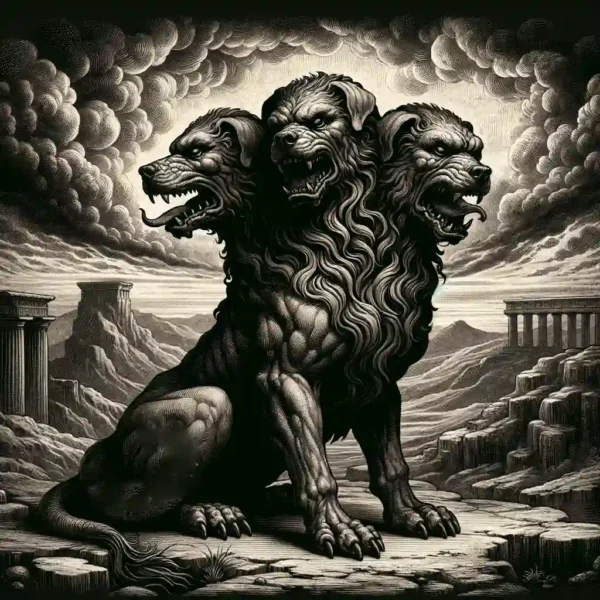
Cerberus, also known as Kerberos in Greek mythology, is a legendary creature depicted as a multi-headed dog, usually three-headed, with a serpent’s tail and a lion’s claws. In Greek mythology, Cerberus is the guard dog of the underworld, the realm of the dead. Its primary duty is to prevent the living from entering the underworld and to keep the souls of the dead from escaping. Cerberus is often portrayed as a fierce and terrifying beast, serving as a symbol of the boundary between the world of the living and the realm of the dead. Its three heads are said to represent various aspects of death or the afterlife, and its presence serves as a deterrent to those who would seek to disturb the balance between life and death.
He isn’t just a monster; he is a civil servant of the afterlife. He is surprisingly friendly to those entering the Underworld (wagging his tail and fawning over new souls), but he becomes a nightmare of teeth and venom to anyone who tries to leave through the gates of hell.
The Three Who Beat the Dog
Only three mortals (or demi-gods) famously bypassed Cerberus:
-
Orpheus: Used the power of music. He played his lyre so beautifully that all three heads fell into a deep, enchanted sleep.
-
Aeneas: Used a “Sop to Cerberus.” The Sibyl who guided him threw the dog a cake laced with honey and sedative herbs.
-
Heracles: Used raw strength. For his 12th Labor, Heracles wrestled Cerberus into submission using only his bare hands (as Hades forbade him from using weapons) and dragged the dog to the surface world.
Origin & History
The origin of Cerberus, is deeply rooted in Greek mythology. According to the most widely known accounts, Kerberos was born from the monstrous union of two primordial beings: Echidna, a half-woman and half-serpent creature, and Typhon, a giant and monstrous figure associated with storms and chaos, making it a sibling to other famous monsters in Greek mythology, such as the Sphinx and Orthrus. The exact origins and lineage of Cerberus may vary slightly depending on different versions of Greek mythology and the accounts provided by various ancient writers and poets. However, its role as the fearsome guardian of the underworld remains consistent across these narratives.
Powers & Abilities
- Impenetrable Vigilance: With three heads, Cerberus never truly sleeps; at least one head is always awake and watching.
- Spectral Tracking: He can "smell" the breath of the living from miles away, making it impossible for a mortal to slip past him unnoticed.
- Sonic Roar: His bark is said to be so loud and terrifying that it can petrify a mortal's heart or echo through the entire cavern of Tartarus.
- Size and Strength: He is massive—large enough to pin a hero like Heracles to the ground or block the massive gates of the palace of Hades.
- Fear Inducement: The terrifying appearance of Kerberos, with its multiple heads, serpent tail, and lion claws, instills fear in those who encounter it.
- Immortality: Like many creatures of Greek mythology, Kerberos is immortal and cannot be killed by conventional means.
- Connection to Hades: Kerberos' allegiance lies with Hades, the ruler of the underworld. It serves as a loyal companion and guardian.
Appearance
- The Heads: Most commonly depicted with three heads, representing the past, present, and future (or, more practically, giving him a 300° field of vision). Some older myths claim he had 50 or even 100 heads.
- The Mane: Instead of hair, his neck and back are often covered in hissing snakes.
- The Tail: He has a serpent for a tail, which can bite or lash out at anyone trying to sneak up behind him.
- The Saliva: His drool is highly toxic. Legend says that where his spit hit the ground, the poisonous plant aconite (wolfsbane) grew.