
★ Overview
SELKIE
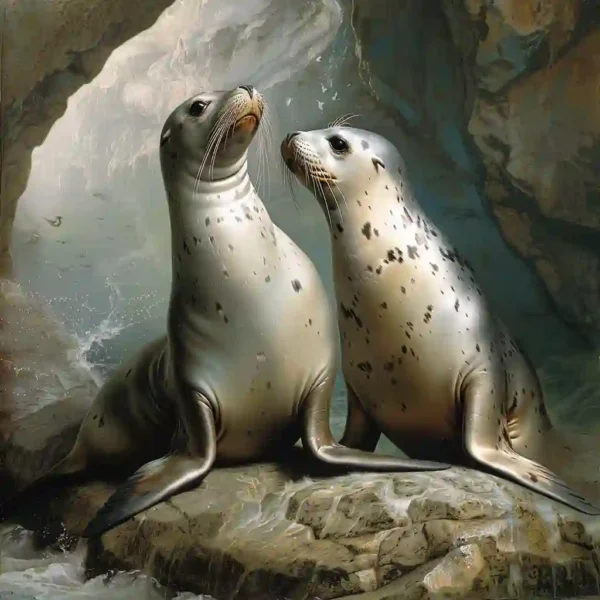
Selkies are mythical creatures found in Scottish, Irish, and Faroese folklore. These beings are seals in the water but can shed their skins to take on a human form on land. The selkie myth is particularly prevalent in the Orkney and Shetland Islands, as well as along the coasts of Scotland and Ireland.Selkies are known for their dual nature as both seals and humans. In their seal form, they are typically described as large, dark-eyed seals. However, when they come ashore, they can shed their sealskin to reveal a human form.
Selkies are gentle, melancholic shapeshifters. Unlike the predatory sirens of Greece, Selkies don’t typically mean humans any harm. They often come ashore to dance in the moonlight or to seek out human lovers. However, they are fundamentally tied to the sea, and their lives on land are almost always the result of theft or tragedy.
Origin & History
The word "selkie" itself is believed to be derived from the Old Norse word "selr," meaning seal. The selkie myth has strong associations with the sea, coastal regions, and the islands of Scotland and Ireland.The tales of selkies have been documented in various forms, including folktales, songs, and poetry. These stories often explore themes of love, loss, and the mystical connection between the human and natural worlds. Many selkie myths involve a human encountering a selkie, often through the discovery of the selkie's sealskin, leading to a complex and often bittersweet relationship.
The Legend of the Stolen Skin
Most Selkie stories involve a fisherman who watches a group of Selkies dancing on the beach. He steals one of their skins and hides it (often in a "sea-chest" or under the floorboards). The Selkie woman, unable to return home, is forced to marry him. They often live together for years and have children, but the Selkie remains perpetually sad, gazing at the horizon.
The story ends when a child accidentally finds the hidden skin. The Selkie mother immediately puts it on and dives into the ocean, often leaving her human family behind, though she may be seen watching her children from the waves for years to come.
Powers & Abilities
- Perfect Shapeshifting: By donning or removing their skin, they can transition perfectly between forms.
- Supernatural Allure: They possess a magnetism that makes it nearly impossible for humans to resist falling in love with them.
- Prophetic Song: In some Scottish ballads (like The Great Selkie o' Suleskerry), they have the gift of foresight, knowing the future even if they cannot change it.
- Marine Agility: They are masters of the current, able to navigate the most dangerous swells and dive to depths unreachable by human divers.
Appearance
- The Seal Form: In the water, they look like ordinary gray seals, though they are often described as having larger, more "expressive" eyes.
- The Human Form: When they shed their skins, they emerge as humans with supernatural beauty—muscular and tall for the men, and graceful with dark, flowing hair for the women.
- The Skin: Their most important physical trait isn't their body, but the seal skin itself. It looks like a heavy, shimmering coat, and it is the only thing that allows them to transform back into a seal.