
★ Overview
MERROW
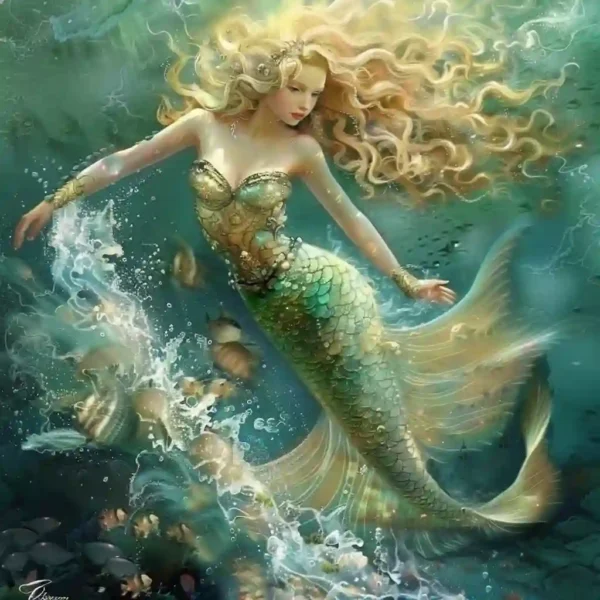
The Merrow, also known as the Muireartach or Murdúch, is a mythical creature in Irish and Scottish folklore. It is often considered a type of mermaid or merfolk, but with distinct characteristics unique to Celtic mythology. Merrows are typically depicted as having a human-like upper body and a fish-like lower body.
Merrows are sea-dwelling people who live in underwater kingdoms below the waves. They are generally friendly to humans—sometimes even marrying them—but they are deeply connected to the ocean. There is a stark difference between the genders: the females are stunningly beautiful, while the males are often described as hideous, with green skin and sharp teeth.
It was believed that Merrow kept the souls of drowned sailors in “soul cages” (cochullen druith) at the bottom of the sea.
Origin & History
The word "Merrow" itself is believed to be derived from the Irish and Scottish Gaelic words "muir," meaning sea, and "oigh," meaning maid or young girl. Thus, the term can be translated as "maid of the sea" or "sea maiden."
The specific characteristics and stories about Merrows can vary across regions and communities, but common themes include their enchanting singing, romantic entanglements with humans, and the mystical properties of their red caps.
The "Stolen Cap" Trope
Almost every Merrow legend follows a similar pattern: A human man finds a Merrow on the beach, steals her Cohuleen Druith (cap), and hides it. Without the cap, she cannot return to the sea and eventually marries him. Years later, she (or one of her children) finds the hidden cap in the rafters or under a floorboard. The call of the ocean is too strong; she immediately puts it on and vanishes back into the waves, leaving her human family behind forever.
Powers & Abilities
- Shapeshifting: By removing their fish-skin or their magical cap, they can walk on land as humans. They are said to be incredibly graceful and make for excellent (though often melancholic) wives.
- Soul-Cages: Merrows are known to keep the souls of drowned sailors in "soul cages" (like wicker baskets) at the bottom of the sea. They don't do this to be cruel; in their logic, they are "saving" the souls from the cold, dark water.
- Storm-Sensing: They have an innate ability to predict the weather. Seeing a Merrow near the shore is often a warning to fishermen that a massive gale is coming.
- Longevity: They live for centuries, far outlasting their human spouses, which often leads to the bittersweet "pining" common in Irish folklore.
Appearance
- Upper Humanoid Body: The upper part of the Merrow's body resembles that of a human. This includes the torso, arms, and head.
- Fish-Like Lower Body: The lower part of the Merrow's body is depicted as fish-like, with a scaly tail instead of legs.
- Webbed Hands: Merrows are often described as having webbed fingers.
- Shimmering Scales: The scales covering the Merrow's fish-like tail are often described as shimmering or iridescent.
- Green Hair: Merrows are commonly portrayed with long, flowing green hair.
- The "Cohuleen Druith": This is their most vital feature. To survive on land, they wear a specialized red, feathered cap (or sometimes a cloak). Without it, they cannot return to their underwater homes.
- The Male Form: Males are squat and monstrous, often having red noses and green hair, looking more like deep-sea goblins than the elegant females.