
★ Overview
MAKARA
The Makara is a mythical creature that holds significance in Hindu, Buddhist, and Jain mythology, as well as in various Southeast Asian cultures. It is a legendary sea-creature that serves as the Vahana (vehicle) of Ganga (the goddess of the Ganges river) and Varuna (the god of the oceans). It is also the emblem on the banner of Kamadeva, the god of love, where it is known as the Makara-Dhwaja.
It is a protective spirit, which is why its image is carved onto the arches of temple doorways (Makara Torana) and the spouts of ritual fountains. To pass through the mouth of a Makara is to undergo a spiritual cleansing, moving from the chaotic waters of the world into the sacred space of the divine.
Origin & History
The origin of the Makara traces back to ancient Indian mythology, where it holds significance in Hindu, Buddhist, and Jain traditions. The creature is deeply rooted in Hindu cosmology and is often associated with water, particularly as a guardian of aquatic realms and a symbol of fertility and abundance.The word "Makara" is derived from Sanskrit and can be translated as "sea dragon" or "water monster." In Hindu mythology, the Makara is often depicted as a mythical sea creature, blending characteristics of various animals such as fish, crocodiles, and elephants.
It is regarded as a symbol of power, protection, and auspiciousness.The earliest references to the Makara can be found in ancient Hindu texts such as the Vedas, the Ramayana, and the Mahabharata. In these texts, the Makara is described as a formidable creature associated with water bodies, including rivers, lakes, and oceans.
Powers & Abilities
- Guardian of the Threshold: As a protector of gateways, it has the power to ward off evil spirits and negative energy from sacred spaces.
- Mastery of the Tides: Being the mount of Varuna, it can navigate the most violent storms and deepest abysses of the cosmic ocean.
- Source of Fertility: It is linked to the "Essence of Life." In many carvings, a "vegetation vine" (vanaspati) grows from its mouth, representing the life-sustaining nutrients found in river silt.
- Amphibious Prowess: Unlike simple fish, the Makara's hybrid nature allows it to exert influence over both the water and the land that touches it.
Appearance
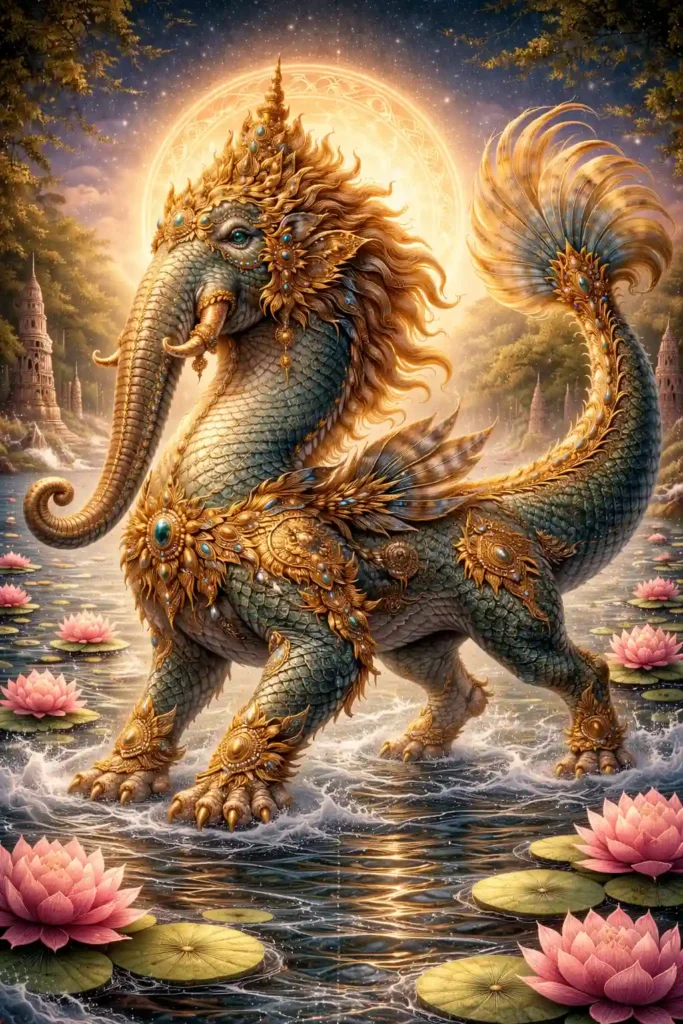
- The Mosaic Body: The Makara is a chimera, traditionally described as having:
- -The trunk of an elephant (symbolizing strength).
- -The jaws of a crocodile (symbolizing predatory power).
- -The feet of a lion or panther (symbolizing terrestrial dominance).
- -The body of a fish or seal (symbolizing aquatic nature).
- -The tail of a peacock (symbolizing beauty and the flow of water).
- The Curled Trunk: It is often depicted with its elephantine trunk raised and curled, sometimes spraying water or holding a lotus flower.
- The Terrifying Maw: Its mouth is usually wide open, revealing rows of sharp teeth, often with a warrior or a floral vine emerging from its throat.
- The Jeweled Scales: In temple art, its body is intricately patterned with scales that resemble stylized leaves or swirling waves.