
★ Overview
MERMAID
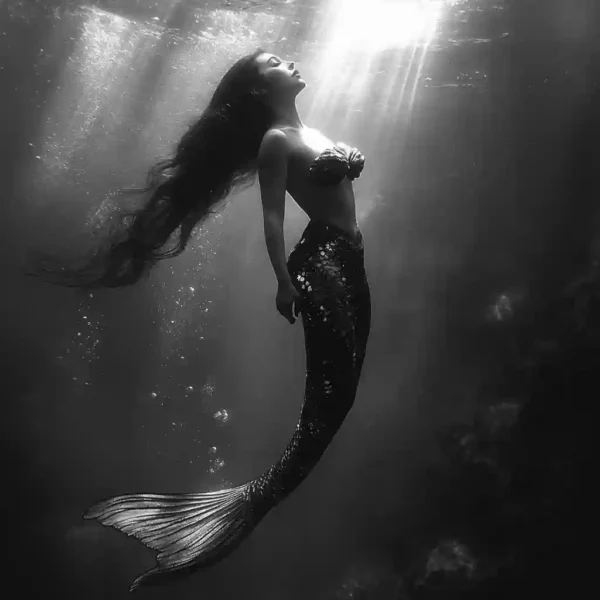
A Mermaid is defined by her dual anatomy: the upper body of a human female and the tail of a fish instead of legs. Her hair is often long, flowing, and adorned with sea-related items like pearls or coral. While modern depictions often make them colorful and shimmering, traditional folklore sometimes described them with greenish skin, webbed fingers, and cold, unblinking eyes. They are frequently seen holding a mirror or a comb, symbols of vanity and their siren-like allure.
In early folklore, they were rarely the “Disney” version we know today. Instead, they were often omens of disaster—seeing one meant a storm was coming. They were the “femme fatales” of the sea, capable of granting immortality, wealth, or wisdom, but just as likely to drag a sailor to a watery grave. Whether they are benevolent goddesses or predatory monsters, mermaids embody the human fascination with what lies beneath the sea.
Origin & History
Mermaid stories span nearly every coastal culture.Ancient Mesopotamia: The earliest mermaid-like figure was Atargatis, an Assyrian goddess who transformed herself into a mermaid out of shame.Greek Mythology: Mermaids are often compared to Sirens, sea nymphs who lured sailors with their captivating songs.
Celtic Mythology: In Scottish and Irish lore, Selkies (seal-people) share similarities with mermaids.Asian Mythology: In Japanese folklore, the Ningyo is a mermaid-like creature bringing misfortune or blessings.Nordic Legends: The Havfrue or sea-woman appears in Scandinavian tales, sometimes helping or harming sailors.West African mythology: Mermaids are deeply connected to the powerful and enigmatic water spirit known as Mami Wata. Unlike traditional Western depictions of mermaids, Mami Wata is a complex and multifaceted figure embodying wealth, power, beauty, and danger.
Powers & Abilities
- The Siren Song: Their most famous power. A mermaid's voice is supernaturally beautiful, capable of enchanting humans into a trance where they will walk off ships or steer into rocks just to get closer.
- Hydrokinesis: Many mermaids can summon storms, control the tides, or create whirlpools when angered.
- Prophetic Vision: In Northern European lore, mermaids are often "spae-wives" (prophetesses) who can see the future and offer warnings to those who treat them with respect.
- Wish Granting: Capturing a mermaid often forces her to grant three wishes in exchange for her freedom, a common trope in Irish and Scandinavian tales.
- Healing Tears: In Asian folklore (specifically China and Japan), it is said that a mermaid’s tears turn into pearls and their flesh, if consumed, grants eternal youth.
- Shapeshifting: In certain myths, mermaids can transform their tails into legs, allowing them to walk on land.
Appearance
- The Iconic Silhouette: The standard image is the upper body of a beautiful woman and the lower half of a scaly fish, complete with a powerful tail fin.
- Varying Textures: Depending on the region, their "skin" can be pearlescent, blue-tinged, or covered in fine scales. Some, like the Japanese Ningyo, were traditionally more monstrous, with monkey-like mouths and fish faces.
- The Vanity Kit: They are almost always depicted with a mirror and a comb, often made of silver or mother-of-pearl. They are said to spend hours on rocks grooming their long, flowing hair (which can be gold, sea-green, or black).
- Camouflage: Some merfolk, like the Selkies of Scotland or the Nixies of Germany, can shed their skins or shapeshift to appear entirely human on land.
- The "Gilled" Details: In more "biological" myths, they may have subtle gill slits on their necks or webbed fingers to navigate the crushing currents.