
★ Overview
FENGHUANG
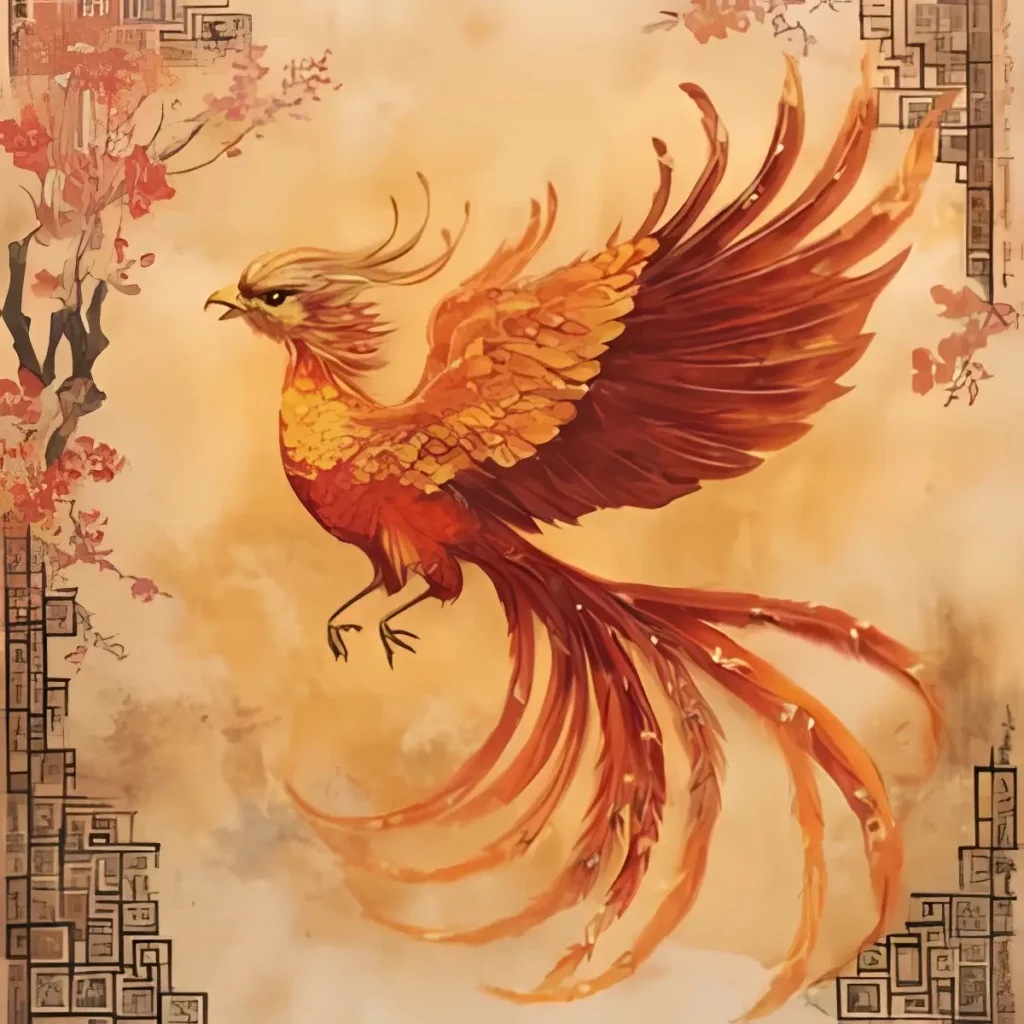
The Fenghuang (凤凰), often referred to as the Chinese phoenix, is a legendary bird in Chinese mythology and culture that symbolizes virtue, grace, harmony, and high status.
Unlike the Western Phoenix, which is defined by its cycle of death and rebirth by fire, the Fenghuang is a symbol of High Virtue, Grace, and Eternal Peace.
The name is a union of opposites: Feng represents the male and Huang represents the female, but over time, they merged into a single feminine entity often paired with the Dragon. While the Dragon represents the Emperor and masculine energy (Yang), the Fenghuang represents the Empress and feminine energy (Yin). It is said that the Fenghuang only appears during times of great peace and prosperity, or when a virtuous ruler sits upon the throne. It is a creature of “The Middle Way,” perching only on the sacred Paulownia tree and consuming nothing but bamboo seeds and pure spring water.
Origin & History
Early Chinese tribes revered various birds as totems. The Fenghuang likely evolved as a composite of these birds.
By the Han Dynasty (206 BCE–220 CE), the Fenghuang became a symbol of the empress, complementing the dragon, which represented the emperor.
Powers & Abilities
- Aura of Harmony: Its mere presence can turn conflict into peace, heal the land, and cause the weather to become perfectly balanced.
- Celestial Song: The voice of the Fenghuang is said to be a perfect musical scale. When it sings, all other birds fall silent out of respect and join in a harmonious chorus.
- Immortality & Purity: While it doesn't "burn," it is an eternal being that cannot be tainted by the filth or greed of the mortal world.
- Vision of Virtue: It has the supernatural ability to sense the "Qi" or moral character of a person, appearing only to those who are truly pure of heart.
Appearance
- The Cosmic Chimera: Traditionally described as having the beak of a rooster, the face of a swallow, the forehead of a fowl, the neck of a snake, the back of a tortoise, the hindquarters of a stag, and the tail of a fish.
- The Five Sacred Colors: Its plumage is a shimmering mosaic of Red, Yellow, White, Black, and Blue. These represent the five Confucian virtues: Benevolence, Righteousness, Propriety, Wisdom, and Sincerity.
- The Solar Tail: Its tail feathers are exceptionally long and ornate, often appearing as a trailing stream of fire or silk that glows with a celestial light.
- The Stature: It is large and majestic, moving with a fluid grace that makes it appear as though it is dancing through the air rather than flying.
- The Inscriptions: Ancient texts claim that the characters for "Virtue," "Duty," and "Ritual" are naturally inscribed upon various parts of its body.