
★ Overview
GRIFFIN
Originating in the Ancient Near East (Sumerian and Akkadian cultures) before becoming a staple of Greek and Medieval lore, it is a hybrid of the two most powerful predators of the known world: the Lion and the Eagle. Because the lion was considered the king of the beasts and the eagle the king of the birds, the Griffin was seen as a creature of absolute sovereignty, guarding the most sacred treasures of the earth and the heavens.
In Greek myth, they were the “Hounds of Zeus” and the guardians of the gold of the Hyperboreans in the far north. During the Middle Ages, they became symbols of the dual nature of Christ (divine and human) and were featured heavily in heraldry to represent courage, leadership, and vigilance. They are the ultimate “watchdogs,” possessing an uncanny ability to sniff out hidden gold and the “hidden truth” within a person’s heart.
Origin & History
The earliest evidence of anything resembling this paarticullar blend of bird and beast can be traced back to artwork made in Egypt and Iran some time before 3,000 BCE. Notably, the first instance of a griffin in Egyptian artwork was carved into a palette intended to store makeup.
The griffin of Iranian mythology is known as a "shirdal" and its name literally means "Lion-Eagle." These creatures appeared in Iranian artwork produced in the regions of Susa and Luristan. Griffins also appeared in various pieces made within Anatolia, the Levant and Syria during the Middle Bronze Age (1950–1550 BCE). Illustrations of animal-raptor hybrids were a common design element of Ancient and Classical Greek artwork, especially around the 6th and 5th Century BCE; this is when tales of the "gryps" began to proliferate as trade through Central Asia flourished. We also have Scythian artworks of griffins, dated between the 6th and 4th Century BCE, but nothing was written down to give them context.
There are multiple accounts of griffins being used to pull chariots owned by Apollo the Greek god of the sun, music and poetry, and Nemesis, the Greek goddess of retribution. This sort of servitude is believed to be why griffins are connected to the sun and also to guardianship. Beyond serving as Olympian beasts of burden, griffins were also known as "hounds of Zeus."
Outside of Greek mythology, griffins feature in a tale about Alexander the Great. It was said that he once captured a pair of griffins and tethered them to his throne. Furthermore, he managed to tame the creatures and rode it into the skies without a saddle, flying over all he had conquered for a solid week.
References/Sources
https://en.wikipedia.org/wiki/Griffin
https://www.theoi.com/Thaumasios/Grypes.html
https://www.intobirds.com/bald-eagles-talons-have-killer-grip/
https://www.popsci.com/10-most-powerful-animal-bites-on-planet/
Powers & Abilities
- Aerial Superiority: They are the fastest and strongest flyers in the mythological world, capable of snatching a fully armored knight and his horse off the ground in a single swoop.
- Feathers: Were purported to be capable of curing the blind
- Treasure Sensing: Griffins have an innate "magnetic" pull toward gold and precious minerals. They don't just guard gold; they are physically drawn to it.
- The "Griffin’s Claw": Their talons are said to change color in the presence of poison. In the Middle Ages, antelope horns were often sold as "Griffin claws" to kings as a way to test their wine for toxins.
- Sonic Screech: Their cry is a mixture of a lion’s roar and an eagle’s shriek, capable of shattering glass and paralyzing smaller creatures with fear.
Appearance
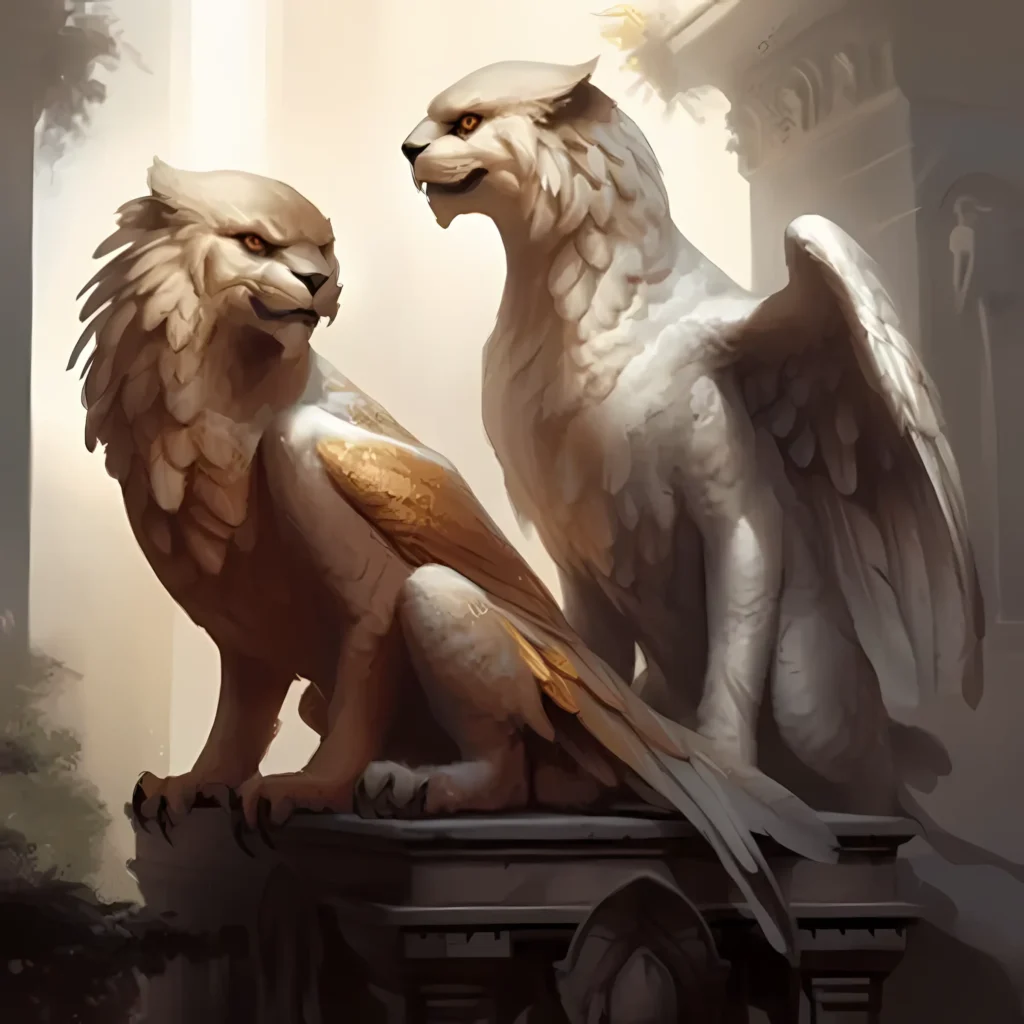
- The Hybrid Build: The standard Griffin features the body, tail, and back legs of a Lion, and the head, wings, and front talons of an Eagle.
- The Ears: Unlike a normal eagle, a Griffin is almost always depicted with pointed, prominent ears (often lion-like or feathered), which signify its heightened sense of hearing.
- The Plumage and Pelt: Their feathers are often described as shimmering gold or white, while their lion-half is a rich, tawny gold. In some legends, their feathers are so strong they are used to make indestructible bowstrings.
- The Tail: While usually a lion's tail, some variations depict a serpentine tail, linking them to the dragon family.
- The Size: They are roughly the size of a large horse, but with a wingspan that can cast a shadow over an entire village.
- The Nest (The Eyrie): They are said to build nests of pure gold, lined with the rarest gems they find while guarding mountain passes.