
★ Overview
HARPY
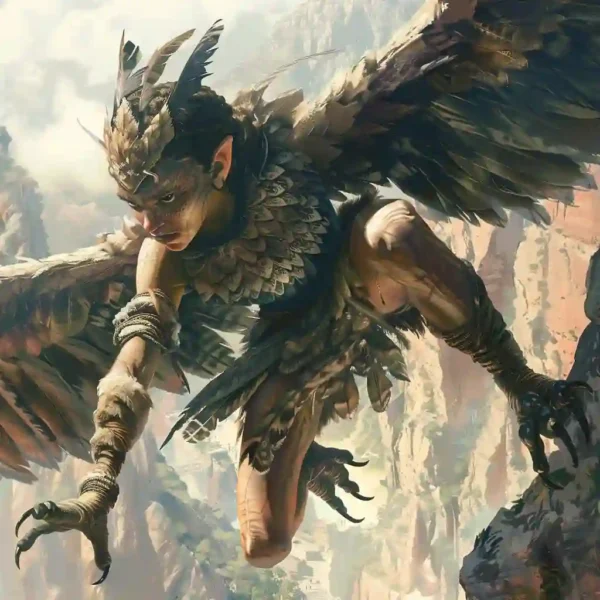
The Harpy is a mythical creature from Greek mythology, often depicted as female winged beings with the faces of women and the bodies of birds. They are associated with storm winds and are generally considered to be spirits of sudden, swift, and tempestuous winds. Harpies are typically depicted with the upper bodies of women, often with a beautiful or seductive appearance, and the lower bodies of birds, including wings and talons.
Harpies are the agents of divine punishment. If a god wanted to torture a mortal without killing them, they sent the Harpies. They don’t just attack; they defile. Their primary job was to snatch away food or people, leaving behind a stench so foul that nothing could live where they had been.
Origin & History
Harpies are first mentioned in Greek mythology, with early references found in Hesiod's "Theogony" and "Homer's "Odyssey." These early sources describe the Harpies as winged spirits associated with storm winds.According to Hesiod, the Harpies are the daughters of Thaumas (a sea god) and Electra (a sea nymph). This makes them siblings to Iris, the rainbow messenger, and the winged horses known as the Harpyiai.
The Torture of Phineus
The most famous Harpy encounter involves King Phineus, who was gifted with prophecy but abused it. As punishment, Zeus blinded him and sent the Harpies to plague him. Every time Phineus sat down to eat, the Harpies would swoop down, steal the best bits, and rot the rest. He was only saved when the Boreads (sons of the North Wind), who were part of the Argonauts, chased the Harpies to the "Turning Islands."
Powers & Abilities
- Sudden Vanishing: True to their name, they strike with the speed of a gust of wind. They "snatch" their prey and vanish into the clouds before anyone can react.
- Psychological Warfare: By constantly stealing food and defecating on whatever is left, they drive their victims to madness and starvation.
- Atmospheric Control: As daughters of Thaumas (a sea god) and Electra (a cloud nymph), they can command localized wind gusts to disorient sailors.
- Whirlwind Flight: They are considered the fastest flyers in mythology, often described as being "swifter than the birds and the winds."
Appearance
- The Hybrid: They have the head and torso of a pale, haggard woman and the body, wings, and talons of a vulture or eagle.
- The State of Being: They are perpetually starving, which is reflected in their sunken eyes and skeletal frames.
- The Filth: They are encrusted with grime and emit a "unbearable odor" that can faint a grown man.
- The Talons: Their brass-like claws are sharp enough to shred armor and carry off full-grown adults.