
★ Overview
MAENADS
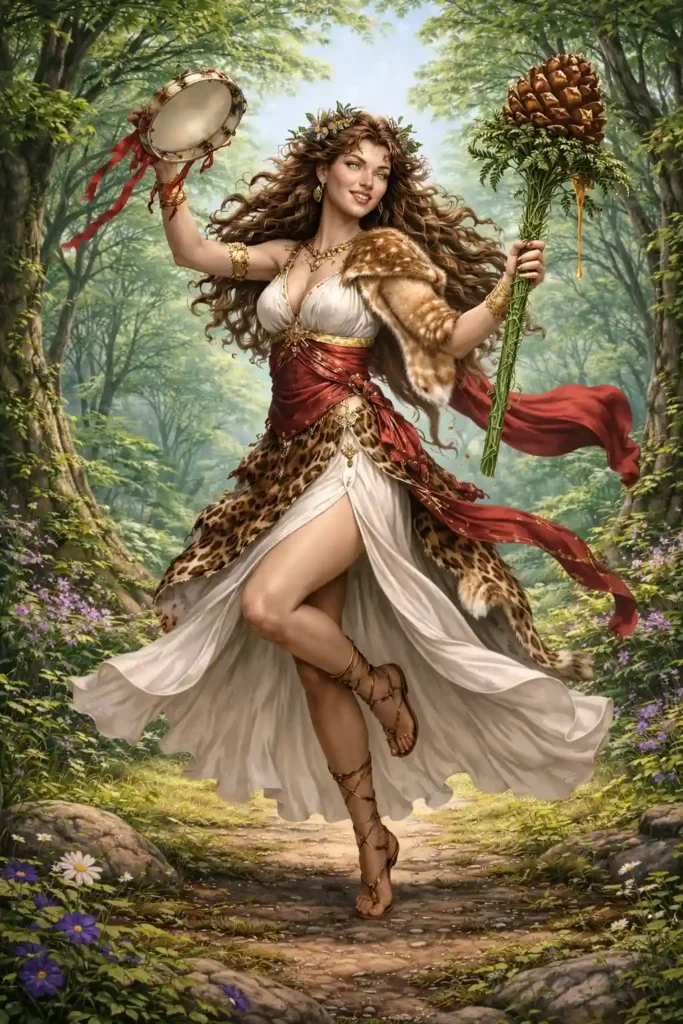
The Maenad (meaning “The Raving Ones”) represents the most dangerous and liberated aspect of the divine. They are the female followers of Dionysus, the god of wine and theater. Unlike the Satyrs, who are born as hybrids, Maenads were originally human women who abandoned their looms and domestic lives to flee into the mountains (oreibasia). There, through the ritual of “Divine Madness,” they transcended their mortal limitations, becoming vessels for the god’s raw, chaotic power.
Their role is to break the rigid shackles of social expectation and domestic duty. Through the oreibasia (the mountain dance), they entered a state of enthousiasmos—literally having the god within them.
Origin & History
The origins of the Maenads lie in the myths and stories surrounding Dionysus, the god whose essence they embody. Dionysus, also known as Bacchus, championed the celebration of life's wild aspects, including revelry, excess, and the hidden, primal desires of the human psyche. The Maenads emerged as his devoted followers, indulging in rituals and dances that allowed them to experience a heightened state of connection with the divine and the intoxicating effects of wine.
In some versions of Greek mythology, there are stories that depict Maenads engaging in frenzied states during which they commit acts of violence, including killing their own children.
One of the most famous accounts of Maenads committing such acts comes from the myth of King Pentheus of Thebes. Pentheus was a ruler who opposed the worship of Dionysus and sought to suppress the Maenads' ecstatic rituals. In retaliation, Dionysus drove Pentheus into a state of madness, causing him to disguise himself as a woman and secretly observe the Maenads' rituals on Mount Cithaeron. In his frenzy, Pentheus was discovered by the Maenads, who mistook him for a wild animal and tore him apart in their trance-like state.
Powers & Abilities
- Ecstatic Dance: Maenads are renowned for their frenzied and ecstatic dances, known as the "maenadic dance" or "bacchic dance." Through rhythmic movements, they enter trancelike states that bridge the gap between the earthly and the divine. In this state, they are believed to achieve communion with the god Dionysus, experiencing a union of the physical and spiritual realms.
- Madness and Transcendence: The rituals of the Maenads often involve a transcendence of the self and a temporary state of madness or divine ecstasy. In this altered state of consciousness, they shed the constraints of societal norms and tap into their primal desires, embracing their innermost emotions with fervor.
- Elemental Connection: As devotees of Dionysus, Maenads are closely connected to the elements, particularly the earth and its natural bounty.
- Mystical Frenzy: During moments of extreme devotion or ritualistic fervor, Maenads are believed to enter a state of mystical frenzy. In this altered state, they are said to be capable of feats beyond the ordinary human capacity, such as displaying enhanced strength or endurance.
Appearance
- The Attire: They are almost always draped in the Nebris (a fawnskin or leopard skin), worn over a light tunic. These pelts are often worn loosely, as they have no regard for the modest dress codes of the city.
- The Hair: Their hair is never bound or braided; it is wild, flowing, and often entwined with living snakes that act as ribbons or crowns.
- The Thyrsus: Every Maenad carries the Thyrsus, a tall staff made of a giant fennel stalk, topped with a pine cone and wrapped in ivy vines. While it looks decorative, it is a deadly weapon in their hands.
- The Crown: They wear wreaths of ivy or bryony, plants that remain green in the winter, symbolizing the eternal life-force of their god.
- The Gaze: During their frenzy, their eyes are described as glowing with a "wild fire" or rolling back in their heads, showing that they are no longer seeing the physical world, but the divine one.