
★ Overview
VANARA
The Vanara is perhaps the most beloved “mythical” race in Hindu epics, specifically the Ramayana. While often translated simply as “monkeys,” the word actually comes from Vana (forest) and Nara (man)—literally “Forest-Dwellers” or “Forest-Men.”
They are a sophisticated, divine race of shapeshifting humanoids who served as the primary allies of Lord Rama.
The Vanara were created by the gods (the Devas) to assist Rama in his war against the demon-king Ravana. Each major Vanara leader was the son of a specific god, inheriting that god’s specific attributes.
Hanuman: Son of Vayu (the Wind God).
Vali and Sugriva: Sons of Indra (King of Gods) and Surya (the Sun God).
Nala and Nila: Sons of Vishwakarma (the Divine Architect).
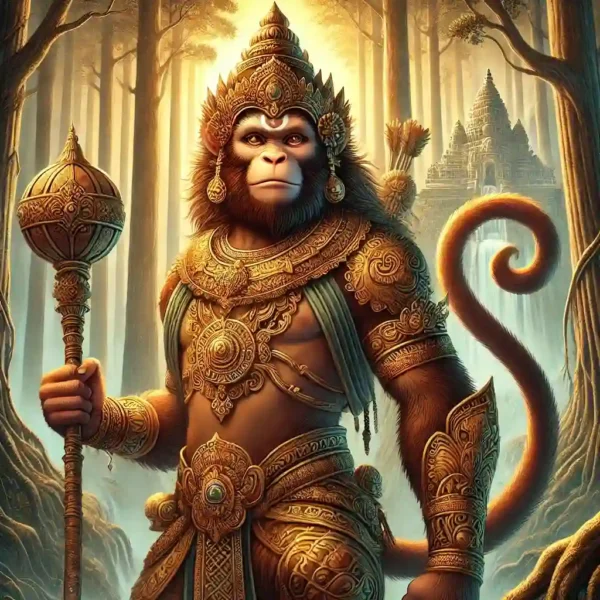
Origin & History
The origin of the Vanaras is intricately tied to Hindu mythology, particularly the epic narrative of the Ramayana. According to the Ramayana, the Vanaras were created by the gods to assist Lord Rama in his battle against the demon king Ravana and his forces.The specific origin stories of the Vanaras vary across different versions of the Ramayana and other Hindu texts. One popular narrative suggests that the Vanaras were born from the sweat of gods and goddesses, as well as from other celestial sources. Another account describes them as descendants of the sage Kashyapa and his wife Arishta, who were transformed into monkeys due to a curse.
Powers & Abilities
- Superhuman Strength: Vanaras are renowned for their immense physical strength, surpassing that of ordinary humans.
- Agility and Speed: Vanaras are highly agile and swift creatures, able to move with remarkable speed and dexterity. They are skilled climbers and adept at navigating through dense forests and rugged terrain with ease.
- Intelligence and Wisdom: Despite their animal-like appearance, Vanaras possess human-like intelligence and wisdom. Their wisdom is often sought by other characters in the Ramayana, including Lord Rama and his allies.
- Shape-shifting: In some versions of the Ramayana, certain Vanaras, such as Hanuman, are believed to possess the ability to change their form or size at will.
- Flight: Hanuman, the most famous of the Vanaras, is renowned for his ability to fly. According to Hindu mythology, Hanuman acquired the power of flight by virtue of a boon granted to him by the gods.
- Magical Powers: Some Vanaras are depicted as possessing magical powers and abilities, such as illusion-casting, elemental manipulation, and divine invocations. These powers are often used to assist Lord Rama and his allies in their battles against demons and other adversaries.
- Divine Blessings: Vanaras are believed to be blessed by various gods and goddesses, endowing them with divine protection and favor. Their loyalty and devotion to Lord Rama are rewarded with divine blessings that enhance their strength, resilience, and effectiveness in combat.
Appearance
- Primate Features: Vanaras are humanoid creatures with bodies resembling monkeys or apes. They possess characteristics such as fur-covered skin, long arms, and prehensile tails.
- Muscular Build: Vanaras are often depicted as having muscular and well-built bodies, indicating their physical strength and prowess as warriors.
- Variety of Forms: While Vanaras are commonly portrayed with primate-like features, their physical appearance can vary. Some depictions may emphasize more human-like traits, while others may lean towards a more animalistic appearance.
- Distinctive Clothing and Ornaments: In artistic representations, Vanaras may be depicted wearing clothing, armor, or ornaments that reflect their status or roles within their society.
- Symbolic Attributes: Some Vanaras may be depicted with symbolic attributes that represent their virtues or affiliations. For example, Hanuman, the most famous Vanara, is often depicted with a mace (gada) and a mountain in his hand, symbolizing his strength and devotion to Lord Rama.