
★ Overview
VETALA
In Hindu mythology, the Vetal (also spelled as Vetala) is a supernatural creature or spirit often associated with ghosts, revenants, or restless spirits. The Vetal is prominently featured in various folk tales, legends, and religious texts, including the ancient Indian collection of stories known as the “Vetala Panchavimshati” or the “Twenty-five Tales of the Vetal.”The Vetal is typically depicted as a powerful, shape-shifting entity with the ability to possess and animate corpses. It is said to inhabit cremation grounds, graveyards, or other places associated with death and burial. The Vetal is often portrayed as mischievous, cunning, and sometimes malevolent, although its behavior can vary depending on the specific narrative.
One of the most famous stories featuring the Vetal is the tale of King Vikramaditya and the Vetal, where a brave king is tasked with capturing a Vetal who resides in a tree in a cremation ground. Each time the king captures the Vetal, it tells him a story with a moral dilemma and poses a question at the end. If the king speaks, the Vetal will escape, returning to its tree. This cycle repeats until the king solves a particularly difficult riddle posed by the Vetal.
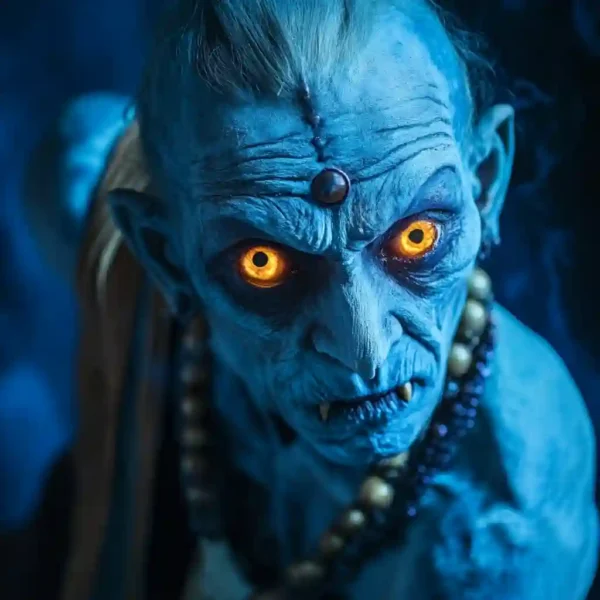
A Vetala is rarely seen in its “true” form, as it is almost always encountered inhabiting a reanimated corpse. When it speaks, its voice is described as a dry, rasping cackle, and its eyes may glow with an unnatural, predatory light. In some descriptions, it can leave the body to appear as a shadowy, translucent wisp before diving into a new host.
Origin & History
Unlike a standard ghost (Preta), which is a disembodied soul, a Vetala is a spirit—often a powerful, semi-divine one—that inhabits and reanimates human corpses.
The Vetala represents The Burden of Knowledge. They are not inherently evil, but they are incredibly mischievous and cynical. They are best known from the Baital Pachisi (Twenty-five Tales of the Vetala), where a Vetala hangs from a tree in a cremation ground and challenges the legendary King Vikramaditya to a contest of wits. The Vetala tells complex riddles; if the King knows the answer but stays silent, his head will burst, but if he speaks, the Vetala flies back to his tree. They are the ultimate "devil's advocates" of myth, using the dead to test the wisdom of the living.
Powers & Abilities
- Reanimation: They can enter any dead body—human or animal—and move it with supernatural strength and agility.
- Retrospection/Omniscience: Vetalas have access to the memories of the bodies they inhabit and possess a deep understanding of the past, present, and future.
- Psychic Riddles: They can enchant listeners with stories that force a moral or intellectual dilemma, effectively paralyzing the victim with thought.
- Invisibility and Flight: In their spirit form, they can travel through walls and fly through the night air.
- Protection from Spirits: If befriended or controlled through tantric rituals, a Vetala acts as a powerful guardian against lesser, more malevolent ghosts.
Appearance
- The Corpse Vessel: A Vetala doesn't have a fixed physical form; it looks like the body it is currently inhabiting. These bodies are often in a state of partial decay, with pale, leathery skin.
- The Bat-Like Stance: They are famously depicted hanging upside down from the branches of trees (usually the Silk-Cotton or Banyan tree) in cremation grounds.
- The Glowing Eyes: Even in a dead body, the Vetala’s presence is revealed by intense, glowing eyes that burn with an ancient, mocking intelligence.
- Claws and Fangs: To better defend their "vessel," they can cause the corpse’s nails and teeth to grow into sharp, predatory points.
- The Shadow Form: When leaving a body, they are described as a smoky, indistinct shape that moves faster than the human eye can follow.