
★ Overview
OGRE
The Ogre is a large, humanoid creature often found in fairy tales, they are abnormally strong and usually low in intelligence.
Ogres are very similar to trolls, with one major difference in lore being that ogres were prone to eat humans, particularly babies and children.
According to Wikipedia, the word ogre comes from an ancient Etruscan god named Orcus. The Etruscans were an ancient people that lived in what is now Italy, and Orcus was a flesh-eating god in their ancient mythology.
Unlike the sophisticated Jotunn or the massive, landscape-forming Titans, Ogres are defined by a singular, terrifying trait: Insatiable Hunger. They are the “cannibals” of fairy tales, famously appearing in stories like Puss in Boots and Hop-o’-My-Thumb.
They are the anti-civilization—beings that live in filth, hoard wealth they don’t use, and see humans not as enemies or allies, but as livestock.
The movie “Shrek” actually turns the notion that the creatures are mean, ugly and hideous on its head. The movie plays on the concept of the angry ogre, in that Shrek the ogre initially presents himself as mean as a way of keeping people and other creatures away from him. The reason he does this is because for his entire life, people and other fairy tale creatures have thought he was a mean and nasty ogre, and none of them took the time to get to know the real Shrek.
Origin & History
According to Wikipedia the first appearance of ogres in literature occurred in the 12th Century, in a poem titled ‘Perceval, li contes del graal’. They became more widely known in the 1600s, when Charles Perrault assembled a collection of fairy tales that had originated in Europe many years before, called ‘Histoires ou contes du temps passe, avec des moralités‘. This translates to ‘Stories or tales from times Past, with morals’.
Powers & Abilities
- Brute Strength: An Ogre can uproot a medium-sized tree or crush a boulder with its bare hands. Their physical power makes them a direct threat to even a group of armored knights.
- Enhanced Scent: They possess a "blood-hound" sense of smell. This led to the famous nursery rhyme trope of smelling the "blood of an Englishman" from a distance.
- Regenerative Digestion: An Ogre's stomach can process almost anything—bone, wood, and even metal—without illness, allowing them to sustain themselves on any organic matter.
- Minor Shapeshifting (Rare): In some early French tales, high-ranking Ogres were capable of transforming into animals, though they usually lacked the wit to use this power effectively.
Appearance
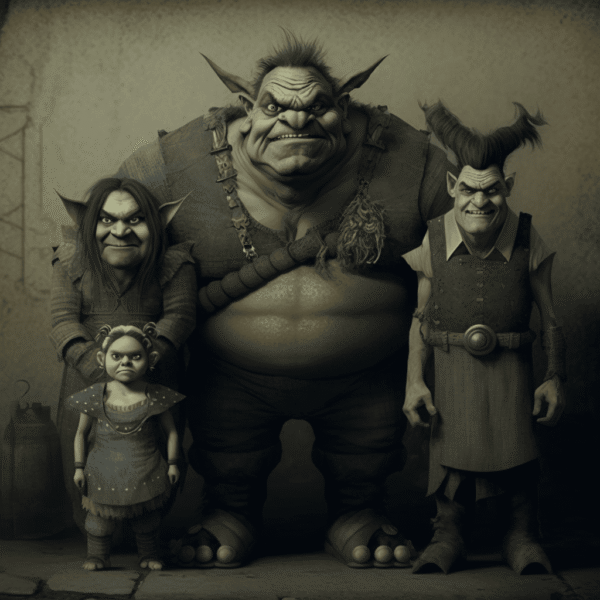
- The Massive Build: Standing between 8 and 10 feet tall, they are incredibly broad-shouldered with a distended, protruding "pot-belly" from constant overeating.
- The Grotesque Face: They often have disproportioned features: a massive jaw, bulbous nose, and cauliflower ears. Some legends describe them with multiple heads or tusks like a boar.
- The Skin and Hair: Their skin is leathery, often appearing sallow, grey, or warty. Their hair is thick, greasy, and unkempt, usually matted with the debris of the forest.
- The Attire: They dress in crude animal pelts or stitched-together hides, often wearing "trophies" like the belts or jewelry of those they’ve defeated.
- The Weaponry: Their signature tool is a colossal wooden club or a rusted, oversized cleaver.