
★ Overview
OILLIPHÉIST
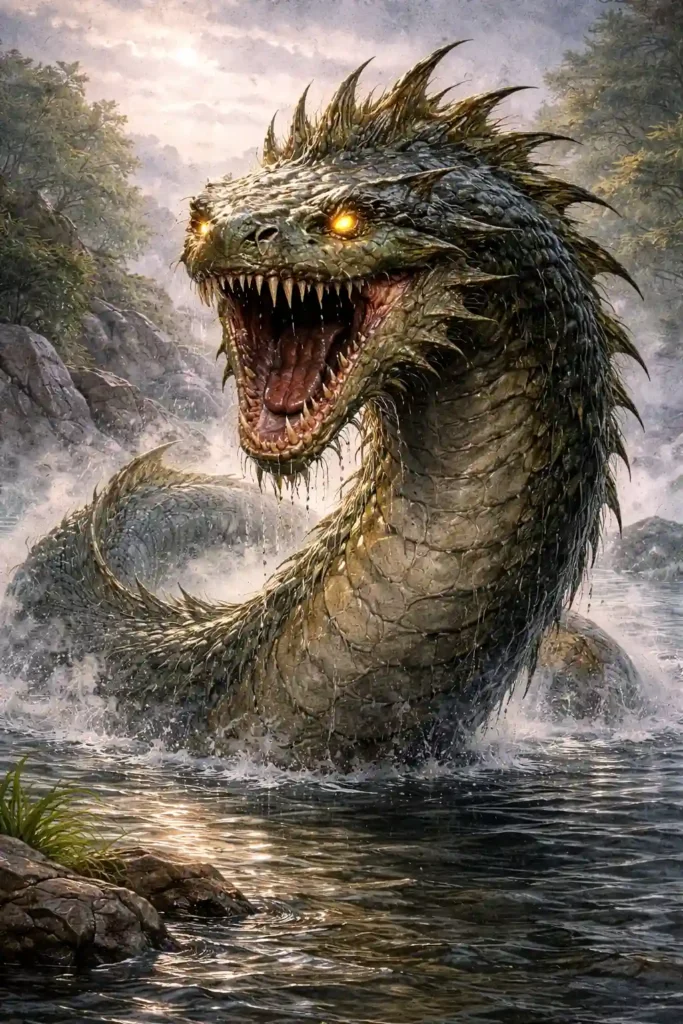
The Oilliphéist is a mythical creature from Irish folklore, particularly associated with the legend of the River Shannon. The name “Oilliphéist” is derived from Irish Gaelic, with “oil” meaning “great” and “péist” meaning “worm” or “serpent.” Thus, the Oilliphéist is often described as a great serpent or water monster that supposedly dwells in the depths of the River Shannon or other bodies of water in Ireland.In folklore, the Oilliphéist is said to be a massive and fearsome creature, capable of causing floods, storms, and other natural disasters. It is often depicted as a monstrous serpent with the power to swallow ships whole or to drag unsuspecting victims beneath the water’s surface.
Unlike the fire-breathing dragons of the European continent, the Oilliphéist is a creature of water, mud, and ancient vengeance.
It is most famous for its role in the hagiography of St. Patrick. According to legend, as the saint was driving the snakes out of Ireland, the Oilliphéist—the greatest of all serpents—realized the era of the old magic was ending. Its legendary act of defiance was to cut a massive path through the Irish landscape in a desperate attempt to reach the sea, carving out the River Shannon with its massive, thrashing body.
Origin & History
The Oilliphéist is a central figure in Medieval Irish manuscripts and folk histories.
The Shannon’s Birth: Legend says that upon hearing of St. Patrick’s arrival, a massive Oilliphéist in Lough Derg became so enraged and terrified that it tore through the earth toward the Atlantic. The furrow it left behind filled with water, creating the longest river in Ireland and Great Britain.
The "Dragon-Swallowing": In another tale, an Oilliphéist swallowed a drunken piper named Ó Ruairc. Unfazed, the piper continued to play his bagpipes inside the monster's stomach. The noise was so grating and the "prickly" pipes so uncomfortable that the beast coughed him up and swore never to eat a musician again.
Guardian of the Lough: Many Irish lakes (loughs) were said to be inhabited by an Oilliphéist that guarded ancient treasures or served as a protector for local Gaelic chieftains before the Christian era.
Powers & Abilities
- Control over Water: The Oilliphéist is believed to have control over the waters it inhabits. It can summon storms, create whirlpools, and cause floods.
- Landscape Alteration: Its sheer size and strength allow it to reshape the earth. By thrashing its tail or charging forward, it can create new riverbeds, islands, and valleys in minutes.
- Toxic Breath: While it doesn't breathe fire, it can exhale a foul-smelling, toxic mist from its nostrils that can wither crops and cause sickness in those who inhale it.
- Sonic Roar: It emits a deep, low-frequency rumble that can be felt in the bones of anyone nearby, often mistaken for distant thunder or the cracking of ice..
Appearance
- The Great Eel-Serpent: It is primarily described as a colossal, wingless serpent or eel, often reaching lengths that could bridge the width of a river (refer to the diagram below for its comparative scale).
- The Dragon-Like Head: Despite its snake-like body, it possesses a monstrous, dragon-like head with massive jaws, sharp fangs, and long, sensory whiskers or "barbels" used to navigate dark water.
- The Bony Crest: Along its spine runs a jagged, bony ridge or crest, which it uses like a saw to cut through the riverbanks and obstacles as it swims.
- The Dark, Slimy Scales: Its skin is not metallic but covered in thick, moss-green or mud-black scales coated in a supernatural slime that makes it impossible to grip or bind.