
★ Overview
KAPPA
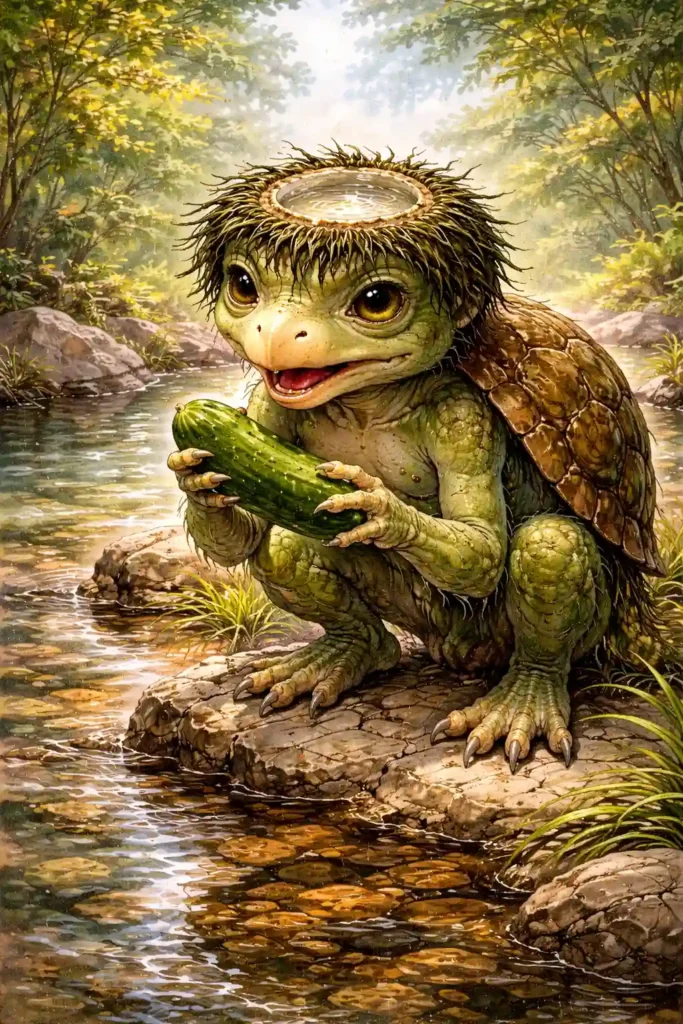
The term “Kappa” refers to a mythical creature in Japanese folklore. Kappa (literally “River-Child”) is a water-dwelling yokai, which is a class of supernatural creatures in Japanese mythology. The Kappa is perhaps the most famous and complex yōkai in the Japanese canon. While the Tanuki is a jolly prankster, the Kappa is a creature of rigid contradictions. It is simultaneously a polite scholar of etiquette, a dangerous predator that drowns children and livestock, and a mischievous imp with a bizarre obsession with cucumbers and the shirikodama (a mythical ball containing the soul, located in the anus).
Kappas are often depicted as humanoid creatures with a reptilian appearance, greenish skin, and a dish-like depression on their heads that holds water. The water in the dish is vital for their existence, and if it spills or dries out, the kappa becomes weakened or may even die.One distinctive feature of the kappa is its obsession with politeness. According to folklore, if you encounter a kappa, you can bow to it. The kappa, being very polite itself, will feel compelled to bow back, causing the water in its head to spill, rendering it vulnerable.
Some stories also suggest that if you bow to a kappa, it may be polite enough to return the gesture and spare you.Kappas are known for their mischievous behavior, and they are said to inhabit rivers and ponds in Japan. They are believed to challenge humans to sumo wrestling matches and have a strong penchant for cucumbers, which are sometimes offered to them as a form of appeasement or protection.
Its legendary acts are a mix of horror and comedy: it might challenge a traveler to a sumo wrestling match, help a farmer with irrigation in exchange for a cucumber, or pull a horse into the depths to feast on its vitals.
Origin & History
The Kappa is a foundational figure in Japanese folklore, with records dating back to the Edo period and earlier, used both as a cautionary tale for children and a protective spirit of the water.
The Cucumber Offering: In many regions, it was tradition to throw cucumbers (the Kappa's favorite food) into the river before swimming to "bribe" the resident Kappa into not attacking.
The Master of Etiquette: Despite being monsters, Kappa are famously, almost pathologically, polite. If a person bows deeply to a Kappa, the creature feels a biological compulsion to bow back—an act that often leads to its own defeat.
The Medical Genius: Folklore suggests that Kappa possess advanced knowledge of bone-setting and medicine. Many legendary human doctors were said to have been taught their craft by a Kappa they had captured or helped.
Powers & Abilities
- Swimming Skills: Kappa are believed to be excellent swimmers, often residing in rivers and ponds.
- Sumo Wrestling Prowess: Kappa are known for challenging humans to sumo wrestling matches. Despite their small stature, they are said to possess great strength, making them formidable opponents.
- Water in the Dish: The dish-shaped depression on the kappa's head holds water, and this water is crucial for their survival. If the water is spilled or the dish dries out, the kappa becomes weakened or may lose its strength.
- Knowledge of Medicine: In some tales, kappa are portrayed as having knowledge of medicine and healing arts.
- Kidnapping or Drowning Humans: In more sinister legends, kappa are said to have the ability to kidnap or drown humans, especially children, who approach or play near bodies of water.
Appearance
- Greenish Skin: Kappas are often depicted with greenish skin, which is thought to help camouflage them in water.
- Humanoid Shape: They have a roughly humanoid shape, with two arms and two legs.
- Webbed Hands and Feet: Kappas are said to have webbed hands and feet, which aid them in swimming.
- Cucumbers and a Dish on their Head: One of the most recognizable features of a kappa is the dish-like depression on its head, called a "sara." This dish holds water, and the kappa's life force is believed to be connected to the water in the dish. If the water spills or dries out, the kappa becomes weakened.
- Beak or Depressed Face: Kappas are sometimes described as having a beak or a face with a depressed area in the center, giving them a distinct appearance.
- Short Stature: Kappas are often portrayed as relatively short creatures, comparable in height to a child.