
★ Overview
SHISA
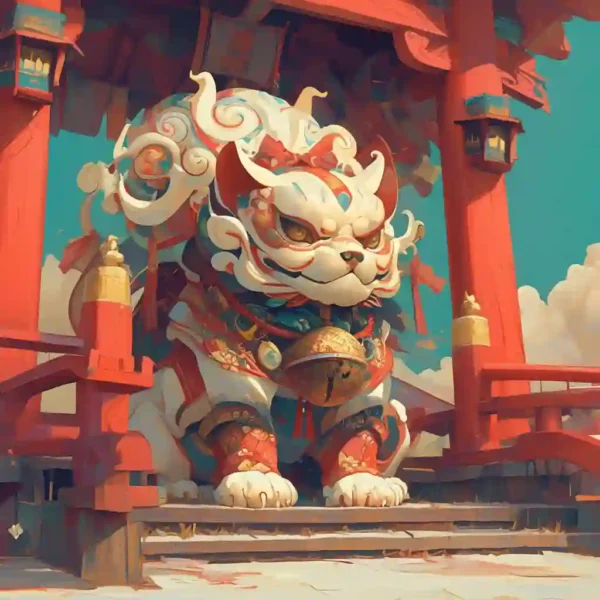
A Shisa is a mythical creature from Okinawan folklore, which is a part of the Ryukyuan mythology in Japan. The Shisa is often depicted as a lion-like creature with a fierce expression, sharp teeth, and a curled tail. It is commonly placed as a guardian at the entrance of homes, businesses, and other buildings to ward off evil spirits.The Shisa is believed to have the ability to protect its owner from malevolent forces and bring good luck. There are usually two types of Shisa: male (with an open mouth to ward off evil spirits) and female (with a closed mouth to keep good spirits in). They are often crafted from stone, wood, or other materials and can vary in size from small statues to larger decorative elements.
The Shisa (often seen in pairs) are cross-breeds between lions and dogs. While they share an ancestry with the Chinese “Foo Dog,” the Shisa is a distinct cultural icon of the Ryukyu Islands, serving as the first line of defense against evil spirits.
You will find them perched on red-tiled roofs, flanking doorways, or guarding the gates of Shuri Castle. They are not “monsters” to be hunted, but spiritual sentinels that keep a household’s energy balanced.
Origin & History
One popular legend regarding the origin of the Shisa involves a Ming Dynasty envoy bringing a pair of Chinese guardian lions to Okinawa as a gift. Over time, these lion statues became associated with local beliefs in protection against evil spirits. The lion statues were modified to suit the artistic preferences and cultural context of the Okinawan people, eventually evolving into the Shisa as it is known today.The Shisa, with its distinctive features and protective symbolism, became an integral part of Okinawan folklore and culture. It is commonly found in various forms, including statues, pottery, and other artistic representations, serving as a guardian charm believed to bring good fortune and safeguard against malevolent forces.
The most famous story tells of an Okinawan king who received a small Shisa figurine on a necklace. When a sea dragon terrorized the village, a local priestess told the king to stand on the beach and hold up his necklace. The Shisa let out a roar that shook the earth, causing a giant rock to fall from the sky and crush the dragon’s tail, turning it into the island of Gana-jima.
Powers & Abilities
- Spiritual Filtration: They act as a "sieve" for a home, catching negative energy (called majimon) before it can cross the threshold.
- Fire Suppression: One of the most famous Shisa legends involves a giant Shisa statue that protected a village from a dragon by letting out a roar so powerful it pinned the dragon under a massive boulder.
- Luck Magnetism: Because of the open-mouthed Shisa, they are believed to literally "inhale" prosperity and happiness from the surrounding air.
- Stone-Turning: Legends say that when a Shisa is truly powerful, it can turn malevolent spirits into stone just by looking at them.
Appearance
- Lion-Like Appearance: The Shisa often has a mane resembling that of a lion, this mane is sometimes depicted as wild and flowing.
- Fierce Expression: The Shisa is known for its fierce and intimidating facial expression. This includes sharp teeth, wide eyes, and a bold posture.
- Curling Tail: Many Shisa statues have a distinctive curled tail, which can vary in shape and style. The tail is often raised upward and can have a spiral or circular form.
- Ears and Horns: Shisas may have pointed ears resembling those of dogs or mythical creatures. Additionally, some depictions include horns or decorative elements on the head.
- Open or Closed Mouth: The male Shisa typically has an open mouth, as if roaring to ward off evil spirits, while the female has a closed mouth to keep in the good spirits.