
★ Overview
DJINN (GENIE)
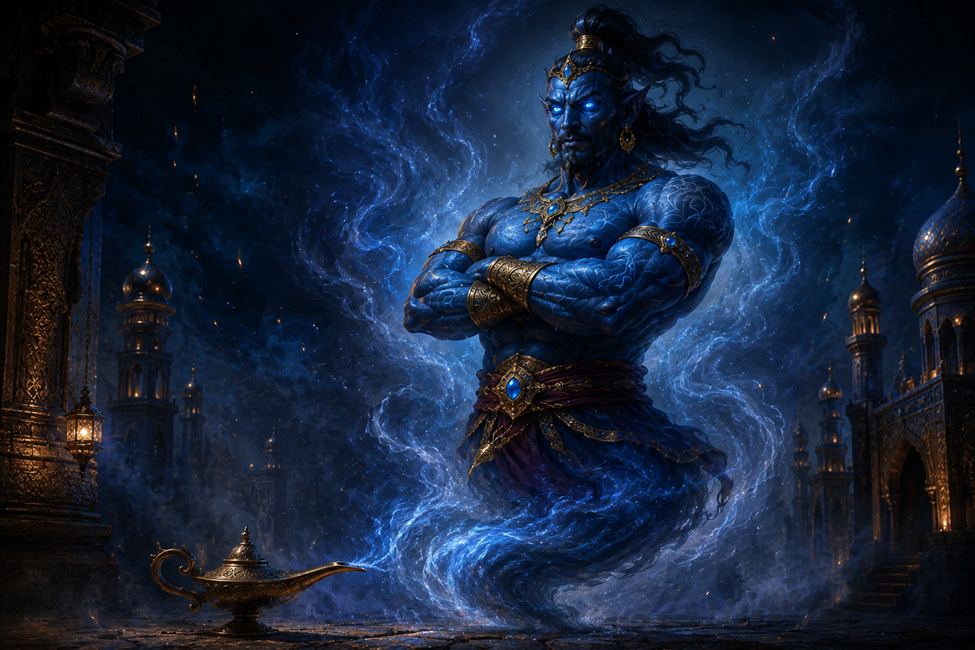
Long before the word genie conjured images of lamps and wishes, the Djinn existed as one of the oldest and most complex beings in Middle Eastern belief. Created from smokeless fire, the Djinn live in a hidden world that runs parallel to our own, unseen but never far away.
Unlike many mythical creatures bound to a single nature, the Djinn possess free will just as humans do. Some are pious and benevolent, others deceptive and dangerous, sharing the same desert homeland as the venomous Manticore, another Middle Eastern legend best avoided after dark. Most Djinn simply wish to be left alone in the desert ruins, abandoned houses, and lonely crossroads they call home. Disturb one carelessly, and the consequences can follow a person for a lifetime.
Origin & History
The Djinn appear throughout pre Islamic Arabian folklore and were later woven into Islamic tradition, where they are described as a distinct creation from humans and angels alike, formed from a smokeless and scorching fire.
Their most famous cultural legacy comes through stories like those in One Thousand and One Nights, where King Solomon is said to have commanded legions of Djinn using a magical ring, binding the most powerful among them to servitude. These tales gave rise to the enduring image of the genie bound to an object, granting wishes to whoever holds it.
Powers & Abilities
- Shape Shifting: A Djinn can take nearly any form, from animals and monstrous beasts to ordinary humans, making them impossible to identify on sight.
- Invisibility: In their natural state, Djinn are unseen by human eyes entirely, moving freely through the physical world unnoticed.
- Possession: Some Djinn are believed capable of possessing a person, influencing thoughts, dreams, or behavior.
- Immense Lifespan: Djinn are said to live for centuries, far outlasting the humans who might encounter them.
Appearance
- The Hidden Form: In their true state, Djinn are said to resemble smoke or fire given shape, flickering and near formless to human eyes.
- The Animal Guise: They frequently appear as black dogs, snakes, or scorpions when moving unnoticed among people.
- The Human Disguise: When interacting directly with humans, a Djinn often takes a human shape, though small details, such as backward facing feet or eyes with no visible pupil, can betray their true nature.
- The Smoke Trail: Many tales describe a faint trail of smoke or a sudden gust of hot wind marking a Djinn's arrival or departure.