
★ Overview
BIGFOOT
Bigfoot is one of the major cryptids of the New World. With around sixty years of exposure in the United States, it’s also one of the youngest of such legends. With very little definitive evidence on which to build a myth and even fewer appearances in popular culture, the Bigfoot is harder to identify than most other monsters.
While sightings exploded into the mainstream following the famous 1967 Patterson-Gimlin film, the legend is rooted in indigenous oral histories stretching back centuries. To the First Nations peoples, the Sasquatch was often seen as a “Wild Man of the Woods”—a powerful, spiritual entity that lived in harmony with nature but demanded respect.
In an age of satellite mapping and constant connectivity, Bigfoot is the shadow in the trees that suggests the world is still bigger and more mysterious than we think. He isn’t a magical monster or a bloodthirsty predator; he is a reclusive, highly intelligent primate (or hominid) that simply wants to be left alone. He is the personification of the wilderness itself: massive, misunderstood, and incredibly elusive.
Its cousin, the Yeti, is located in the Himalayan Mountains.
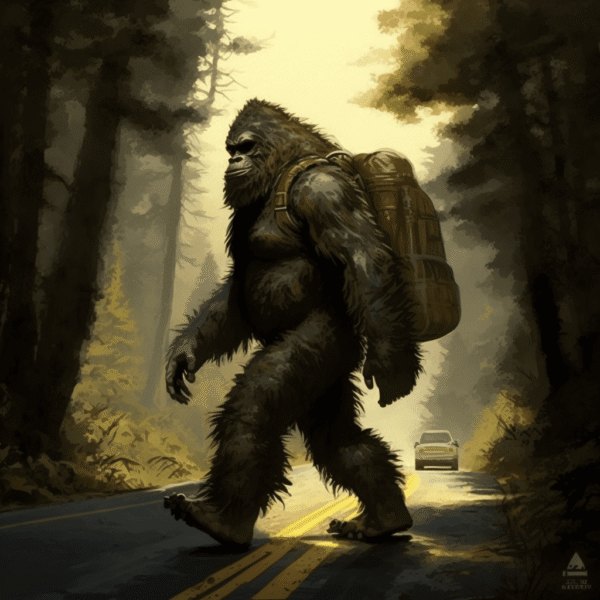
Origin & History
Given that Bigfoot is generally a New World phenomenon, it’s fairly easy to trace its roots. The creature is a proud descendant of numerous wild-man myths from across the world, simply transported into an American context.
In this case, you can even pinpoint the decade in which Bigfoot became a part of American culture – the 1950’s. Initially accused of causing mischief in logging camps, the creature became a fully-fledged phenomenon in the decades since.
While the original Bigfoot prints of folklore are admittedly part of a hoax, there are several Native American myths that describe a similarly elusive creature. Native tribes generally identified the creature as generally benign, if somewhat troublesome.
The Bigfoot’s American nature has also led to development of several sub-species of the creature, including the Skunk-Ape of the American Southeast. It seems that North America is, at least in the minds of many, the type of place that simply needs its own species of giant, legendary creature.
Powers & Abilities
- Infrasound Emission: Some researchers believe Bigfoot can emit low-frequency sounds that cause humans to feel intense dread, nausea, or "paralysis," allowing him to slip away undetected.
- Vocal Mimicry: He is known for "wood knocking" (banging logs together) and "Samurai chatter"—a complex, high-speed series of whistles and grunts used to communicate with others of his kind.
- Olympic-Level Stealth: Despite his size, he can move through dense brush with zero noise, utilizing "step-in-step" walking patterns that make a single creature look like a much smaller animal.
- Night Vision: His eyes are biologically adapted for the deep forest, frequently reported to have a silvery or yellowish "eye-shine" when caught in a beam of light.
Appearance
- The Hirsute Hide: He is covered in a thick, matted coat of hair ranging from dark cinnamon-brown to charcoal-black. The hair is often described as being 3–4 inches long, shedding water easily in the rainy Northwest.
- The Stature: Standing between 7 and 10 feet tall, he possesses a massive, barrel-chested build with no visible neck—his head sits directly on his powerful trapezius muscles.
- The Facial Features: His face is a blend of human and ape, with a heavy, prominent brow ridge, a flat nose, and thin lips. His skin is leathery and dark, often compared to an old work glove.
- The "Conical" Head: Many witnesses describe a "pointed" or sagittal crest on the top of the skull, similar to a male gorilla, which anchors massive jaw muscles.
- The Signature Feet: He leaves massive, flat-footed prints, typically 14 to 24 inches long, with five distinct toes and a "mid-tarsal break" that allows for flexible movement on uneven mountain terrain.