
★ Overview
FENRIR
Fenrir is the son of the god Loki and Angrboda, who is a goddess of the Underworld (or Hel). He is also a brother to the serpent named Jormungand and the goddess Hel.
Fenrir, also called Fenris Wolf, or Vanagandr (which means “monster of the River Van”) is a mythological wolf in Norse mythology. The legend of Fenrir developed in the 13th century, and he has since been the subject of numerous poems, literary references, and artistic renditions.
Fenrir is among the most fearsome and troublesome creatures in Norse mythology. He was ascribed magical powers of prophecy, but he specialized in detecting bad omens. After his birth, Fenrir grew at an abnormally rapid rate. Because of his unusual growth rate and tendency toward troubling activities, Fenrir was ultimately captured and bound by a group of Norse gods. In retaliation for his torture, Fenrir bit off the hand of the god Tyr. For that action, he was forever deemed a ferocious and troublesome creature.
Origin & History
In Norse legend, Fenris Wolf is very much a product of both parents. He is among the coldest and most cunning of all mythological creatures. Fenrir was devious from the start, and his wayward actions prompted concern among other Norse gods.
According to legend, Fenrir was wrested from his parents and raised by Aesir gods, who wanted to raise him from birth to correct his devious ways. However, their attempts to control him failed. After the first unsuccessful chaining, in which Fenrir bit through the strong chain with minimal effort, the gods told him the chaining exercise was merely a game. But Fenrir, who was stronger than the Aesir gods realized, easily broke through the second set of chains.
It was only Tyr, the bravest of the Aesir gods, who was finally able to hold Fenris Wolf with a strong enough tether. Fenrir lashed out in anger, and managed to sever Tyr's arm in response to his actions. Fenrir was then reportedly chained to a boulder, from which he never escaped. Fenrir howled endlessly, and ultimately produced a river of saliva called Van, which flowed uninhibited from his mouth. Fenrir ultimately broke free from his boulder at Ragnarok, and proceeded to destroy much of the Nine Worlds, including killing Odin. Fenrir is eventually killed by Odin's son, Viðarr, who wears a magical boot made from all the leather scraps humans have ever discarded. Viðarr steps on Fenrir's lower jaw and rips his head apart.
Powers & Abilities
- Infinite Growth: Fenrir’s size and strength are not fixed; he grows in direct proportion to the fear and the "age" of the world.
- God-Slaying Strength: He possesses the raw physical power to shatter any mundane metal. He broke the heavy chains Lædingr and Dromi as if they were cobwebs.
- The World-Eater’s Maw: His bite is absolute. He doesn't just kill; he consumes. During the end times, his hunger is said to be so great he would eat the sun if his brother Sköll hadn't already claimed it.
- Eldritch Intellect: Unlike a common beast, Fenrir is sentient and capable of speech. He understood the gods' trickery and waited for the right moment to demand a "sacrifice" (Týr’s hand) as a guarantee.
Appearance
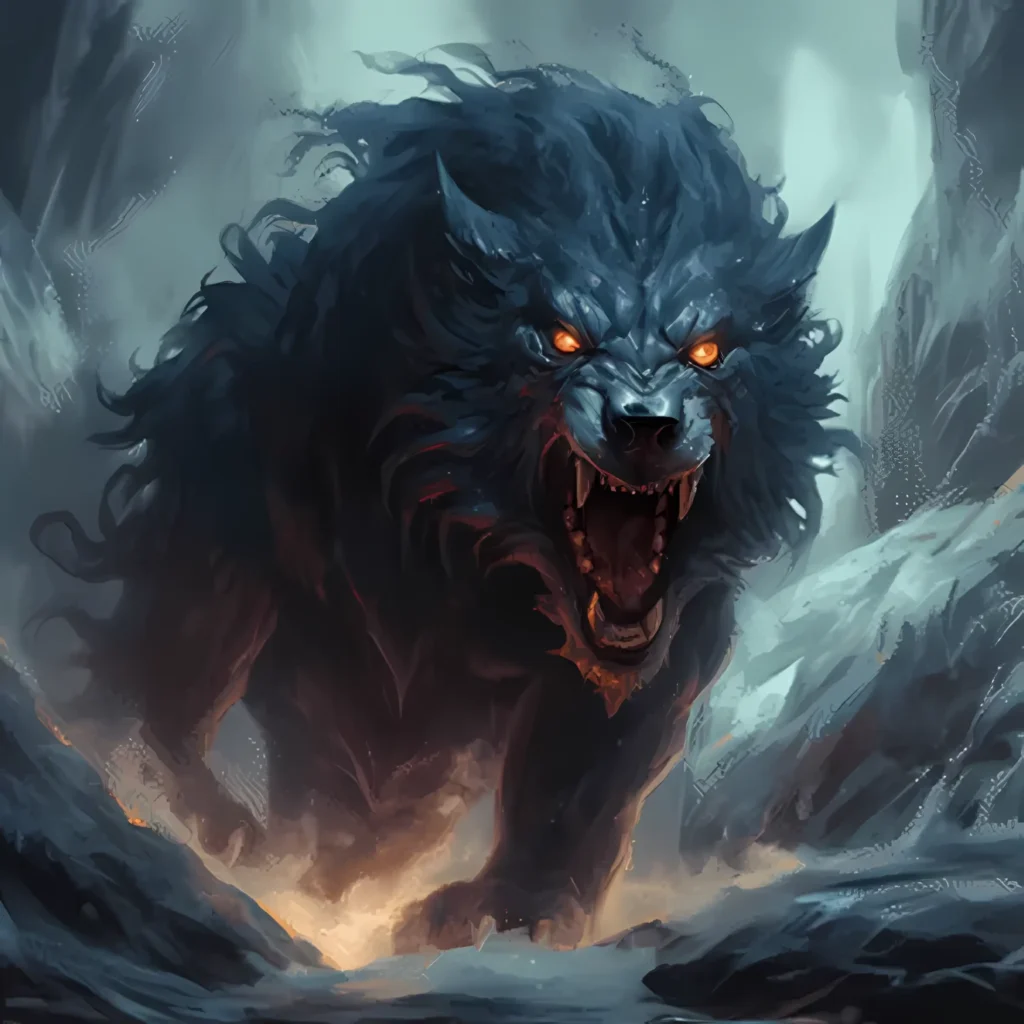
- The Gargantuan Scale: As a pup, he was manageable, but by adulthood, he grew so large that when he opens his mouth, his lower jaw rests on the earth and his upper jaw touches the sky.
- The Shaggy, Ash-Grey Fur: His coat is described as a thick, matted expanse of grey and black fur, often caked with the frost of the iron woods or the blood of those who tried to bind him.
- The Glowing Eyes: His eyes burn with a predatory, amber fire—the visual manifestation of his simmering rage against the Æsir.
- The Gleipnir Ribbon: Even after he breaks free, he is often depicted with remnants of Gleipnir—the thin, silk-like magical ribbon that held him for centuries—trailing from his neck or limbs.