
★ Overview
HULDER
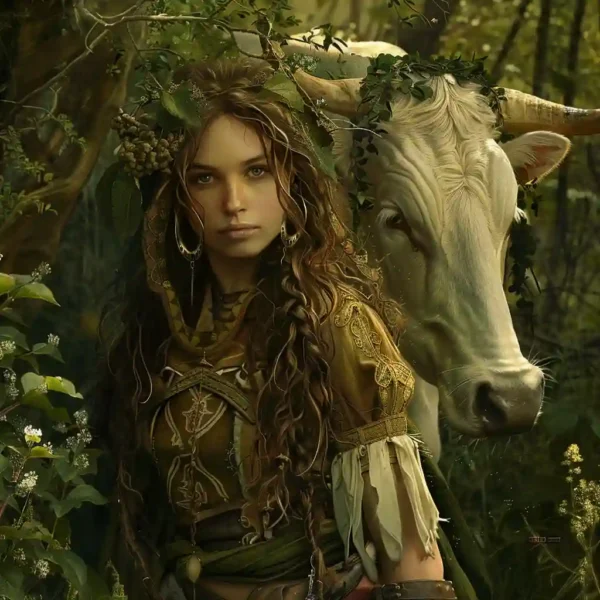
The Hulder is a mythical creature from Scandinavian folklore, particularly in Norwegian and Swedish traditions. It is often depicted as a beautiful, seductive forest-dwelling being with some characteristics that set it apart from humans. The Hulder is usually portrayed as an incredibly beautiful woman with long hair and a stunning appearance. However, she is said to have a cow’s tail or sometimes even the back of a hollowed-out tree, which she hides beneath her clothes. Despite these unique features, the Hulder’s beauty is often irresistible to those who encounter her.
Unlike the Kelpie (who wants to eat you) or the Tomte (who wants to work), the Hulder’s primary motivation is often marriage.
It was believed that if a Hulder could marry a human man in a Christian church, her tail would fall off and she would gain a human soul.
The Marriage Contract: If a man marries a Hulder, he usually becomes very wealthy (thanks to her magical cattle). However, if he is ever cruel to her, she will use her supernatural strength to beat him or ruin his life.
The “Tail” Etiquette
A famous trope in these stories involves a human noticing her tail during a dance or a conversation.
The Rude Way: If the man laughs or points at the tail, the Hulder will curse him with madness or bad luck.
The Polite Way: If he says, “Fair maiden, your garter is falling,” or “You’re dropping your train,” she will appreciate the discretion. She might reward him with a pot of gold or ensure his farm is the most prosperous in the valley.
Origin & History
One theory suggests that the Hulder may have roots in ancient fertility goddesses or nature spirits worshipped by early Scandinavian peoples. Over time, as Christianity spread throughout the region, pagan beliefs were gradually incorporated into Christian mythology, and figures like the Hulder took on new interpretations and symbolism.
The Hulder is the personification of the Seter (the high summer mountain pastures). In the old days, young men and women spent months alone in the mountains tending cattle. The Hulder represented the loneliness, the sexual temptation, and the literal "danger" of the mountain wilderness.
She is the "Mother Nature" of Scandinavia—beautiful and generous if respected, but hollow and devastating if betrayed.
Powers & Abilities
- The Hulder-Call (Huldrelokk): She has a singing voice or a haunting flute melody that acts as a hypnotic spell. Men who hear it become "mountain-struck" (bergtatt) and will follow her blindly into the cliffs.
- Supernatural Strength: She can take a heavy iron horseshoe and straighten it with her bare fingers as if it were a piece of wet pasta. She often does this in front of men to show them what will happen if they are ever unfaithful to her.
- The "Blue" Cattle: She owns herds of magical, fat, blue-grey cattle that produce incredible amounts of milk and never get sick.
Appearance
- Beauty: The Hulder is renowned for her exceptional beauty. She is often depicted as having long, flowing hair, fair skin, and captivating features that surpass those of ordinary women. Her beauty is said to be alluring and mesmerizing to those who encounter her.
- Cow's Tail: One of the most distinctive features of the Hulder is the presence of a cow's tail, which she conceals beneath her clothing.
- Back of a Tree: In some variations of the legend, the Hulder is said to have a hollowed-out back resembling the inside of a tree. This feature is hidden from view, and she may use her long hair or clothing to conceal it.