
★ Overview
POPOBAWA
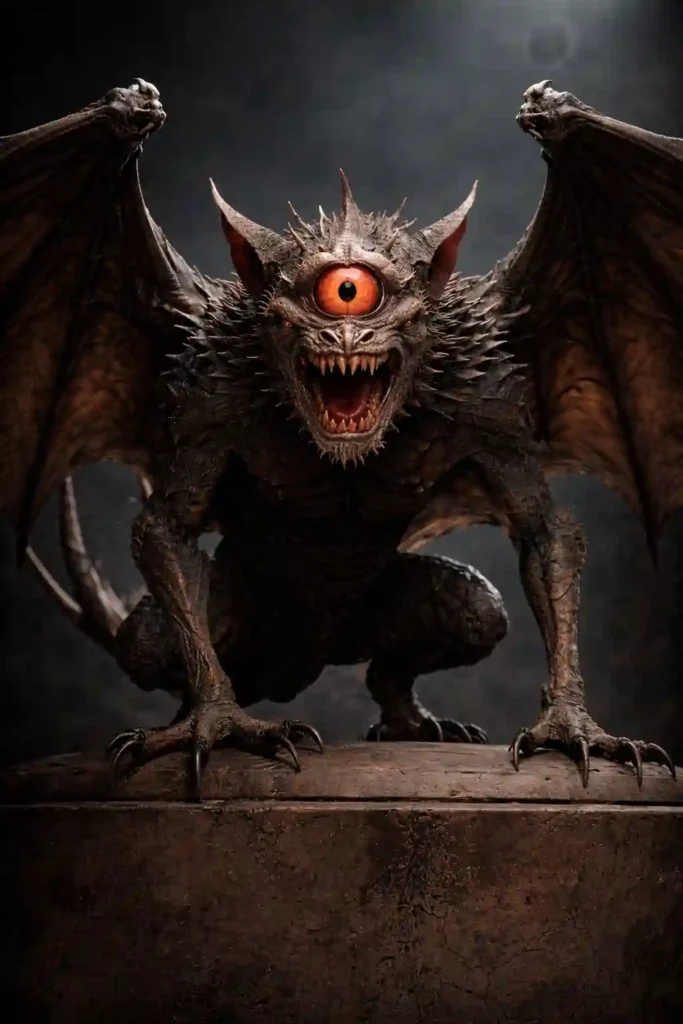
The Popobawa, (Its name literally translates to “Bat-Wing” in Swahili , popo meaning bat, and bawa meaning wing). a cryptid from the folklore of Zanzibar, emerges from the darkness of night to sow fear and uncertainty. With its reputation as a shape-shifting entity that visits communities under the cover of darkness, although sightings in the daytime are also reported.The creature is occasionally linked with the presence of a sulfurous smell, although this connection isn’t consistently observed.
Popobawa targets individuals regardless of gender or age, extending its attacks to men, women, and children alike.It might assail every member within a household before proceeding to another nearby residence. Its nighttime intrusions could involve straightforward physical aggression or even poltergeist-type occurrences. However, the most dreaded aspect is its potential for sexual assault, particularly the anal violation of both men and women.
Unlike ancient myths that feel distant, the Popobawa is a living urban legend, with major “outbreaks” reported as recently as the 21st century.
One of its most distinctive traits is its demand for publicity: it frequently tells its victims that if they do not tell others about the attack, it will return.
Origin & History
The origins of the Popobawa's legend can be traced to the island of Zanzibar, where it has become an integral part of local folklore. The term "Popobawa" translates to "bat-wing" in Swahili, reflecting the creature's association with nocturnal creatures and its ability to fly.
It is a spirit of vengeance.
The Released Jinn: A popular origin story suggests that an angry sheikh in the 1970's released a powerful jinn to take vengeance on his neighbors in the 1970s. The sheikh eventually lost control of the spirit, which then began to roam the islands at will.
Political Omens: Many locals associate the creature's appearance with election cycles or periods of unrest. Some believe it is the vengeful ghost of a former president or a spirit summoned by political factions to intimidate the populace.
Mass Hysteria and Sleep Paralysis: Skeptics and psychologists often point to the Popobawa as a classic example of mass sociogenic illness combined with sleep paralysis—the sensation of a heavy, demonic presence sitting on one's chest during the night.
In the aftermath of an assault, victims are frequently coerced into sharing their ordeal with others, under the threat of further encounters with the Popobawa. The creature's presence often triggers a state of panic, leading many individuals to adopt preventive measures against potential attacks. These measures include spending sleepless nights outside their dwellings, often congregating around an open fire alongside family members and neighbors. The phenomenon of panic tends to be most prevalent in Zanzibar, encompassing the entirety of Pemba Island and the northern and western regions of Unguja Island, which includes Zanzibar town. Similar episodes of panic have also surfaced in places such as Dar es Salaam and other coastal towns on the Tanzanian mainland.
Powers & Abilities
- Nocturnal Assault: It attacks victims in their homes at night, often while they are in bed. It is known for causing "sleep paralysis"—pinning victims down so they cannot move or scream.
- Psychological Warfare: The Popobawa is a "shame" monster. It demands that its victims tell others about the attack. If they keep it a secret, it returns to haunt them and their neighbors even more aggressively.
- Invisibility: It can pass through locked doors and solid walls, making physical security (like the Tokoloshe's bricks) largely useless.
- Sulfur Stench: It emits a smell so strong it can be detected from several houses away, acting as a warning of its arrival.
Appearance
- The Cyclops: Its most terrifying feature is a single, glowing eye in the center of its forehead.
- The Bat: It possesses massive, leathery wings (hence the name).
- The Shapeshifter: It can take human form or animal form (most commonly a small bat or a cat), but its presence is always marked by a foul, sulfurous smell.