
★ Overview
FRANKENSTEIN
Created by the obsessed scientist Victor Frankenstein in Mary Shelley’s 1818 novel, the Being is not a “monster” by birth, but a discarded “Adam.” The original literary creature was a highly intelligent, sensitive, and eloquent being who learned to speak and read by observing a family in the woods. He is a tragic figure—a collection of graveyard remains brought to life by “galvanism” (early electrical theory), only to be abandoned by his creator for being “too hideous” to love.
He is the “New Man,” a being born without a soul or a social history, forced to navigate a world that hates him for his appearance. His story is one of profound loneliness turning into murderous rage. He isn’t a supernatural ghost or a demon; he is a biological miracle turned into a psychological nightmare.
Origin & History
Frankenstein was a book written by Mary Shelley, a 19th century writer. It was originally published anonymously in 1818, and tells the story of a scientist who is conducting morally questionable experiments.Contrary to popular belief, the monster that the scientist Dr. Victor Frankenstein created was not named Frankenstein. The monster was never given an official name in the book, but Victor refers to it as "wretch," "devil," "ogre," and other names. In modern day, it is perfectly acceptable to call the monster Frankenstein.Victor used methods of alchemy and chemistry to create the monster. During the course of the story, the monster displays human like emotions; however, he is seen as ugly to humans and this makes him reclusive, dangerous, and angry. Eventually, the monster, enraged by his own creation, seeks out his creator for revenge.
Dozens of version of Frankenstein's monster has appeared on film and television. The most iconic version of the monster comes from three films produced in the 1930s: Frankenstein, Bride of Frankenstein, and Son of Frankenstein. More recent renditions of Frankenstein's monster has appeared in movies such as Hotel Transylvania, Van Helsing, and the yet to be released Bride of Frankenstein.Frankenstein's monster has also appeared in other forms of media. Both Marvel and DC Comics have versions of Frankenstein that exist in their canon. He has also appeared in numerous Castlevania video games, serving as a boss. The monster has appeared in various cartoons, like Looney Toons and the Flintstones.
Mary Shelley, the author of the original story, is credited as creating the horror genre with the creation of Frankenstein's monster. The inspiration for the story could be credited to a volcanic eruption in 1816. This eruption left the globe in shambles, causing irregular weather throughout the entire world. Shelley herself said that bizarre weather kept her indoors during the Summer, making it possible for her to put her mind elsewhere. Without the eruption of 1816, Mary Shelley likely would have never wrote her story.
Powers & Abilities
- Superhuman Constitution: He possesses incredible strength, far surpassing any mortal. He can scale the vertical cliffs of the Alps and survive in sub-zero temperatures without clothing.
- Genius-Level Intellect: In the novel, he taught himself several languages and read classics like Paradise Lost. He is a master of psychological manipulation and philosophical debate.
- Survivalism: He requires very little food (mostly berries and nuts) and can run for days without tiring, making him an unstoppable pursuer.
- Emotional Resilience (Initially): He was born with an innate capacity for kindness and empathy, which was only "extinguished" after repeated trauma.
Appearance
- The Stature: He stands at a towering 8 feet tall, designed to be "beautiful" by Victor, though the end result was horrifying.
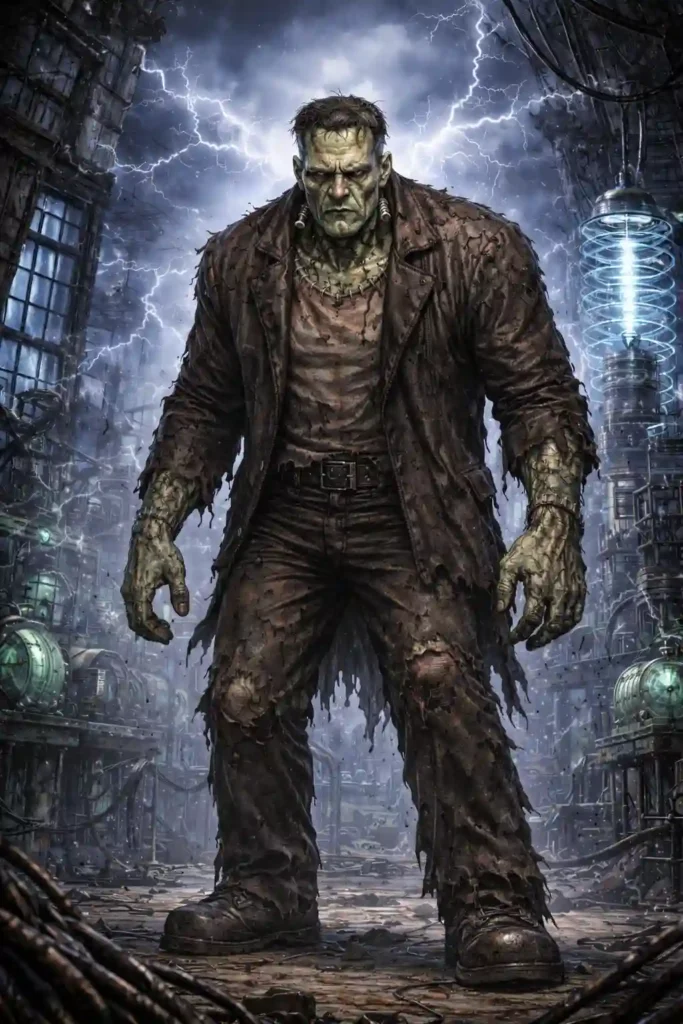
- The Skin: His skin is described as yellow, stretched so thin that it barely covers the "work of muscles and arteries beneath." other versions picture him green.
- The Face: He has lustrous, flowing black hair, teeth of "pearly whiteness," and watery, dull-grey eyes that seem set in the same color as the pale sockets they are buried in.
- The Cinematic Icon (Boris Karloff): This is the version with the flat head, neck bolts (electrodes), and heavy brow, which became the cultural shorthand for the character in 1931.
- The Stitches: He is a patchwork of "the dissecting room and the slaughterhouse," with visible scarring where various parts were joined.