
★ Overview
AZIZA
The Aziza are mythological beings that are said to be spirits of the forest in the traditional beliefs of the Yoruba people of Nigeria and Benin. They are known to be benevolent and are believed to bring good fortune and protection to those who respect and honor them.The Aziza are believed to be very ancient and powerful beings, and as such, are revered and feared by many. They are said to be immortal and can only be seen by those who possess the gift of clairvoyance or by those whom they choose to reveal themselves to. In Yoruba culture, the Aziza are often invoked during important ceremonies and rituals, such as weddings, funerals, and initiation ceremonies. Offerings of food, drink, and other gifts are made to them in exchange for their blessings and protection.Despite the spread of Christianity and Islam in the region, belief in the Aziza and other traditional spirits remains strong among many Yoruba people. The Aziza continue to be celebrated and honored in various ways, including through music, dance, and art.
Origin & History
The origins of the Aziza can be traced back to the Yoruba people of West Africa, who believe in a rich pantheon of spirits and deities that inhabit the natural world. The Aziza are considered to be one of many nature spirits, and are closely associated with the forests and other wild places.In Yoruba mythology, the Aziza are said to be ancient beings that have existed since the dawn of time. They are believed to have been created by the powerful and mysterious force known as Olodumare, who is often described as the supreme deity of the Yoruba pantheon.According to legend, the Aziza were created to serve as guardians of the forest and its inhabitants. They are said to have a deep understanding of the natural world and are able to communicate with plants and animals in ways that humans cannot.
They are believed to be capable of moving great distances in a single day and can withstand extreme conditions that would be challenging for humans.There is only one documented source for the existence of winged Aziza, which was recorded after the Atlantic slave trade and contact with Europeans.
Powers & Abilities
- Pyrokinesis & Fire Mastery: As the original bringers of fire, they can ignite small flames at will and are immune to heat.
- Botanical Healing: They possess an absolute knowledge of every leaf, root, and berry. They can cure almost any mundane or magical ailment using forest herbs.
- Hunter’s Blessing: They can grant "God Luck" to hunters, making prey easier to find and protecting the hunter from dangerous predators.
- Illusion & Guidance: They can warp the perception of the forest to lead a respectful traveler home or to lead a greedy intruder into a confusing loop of thorns.
- Dimensional Phasing: They can vanish into the "spirit world" inside an anthill or tree trunk, making them impossible to capture.
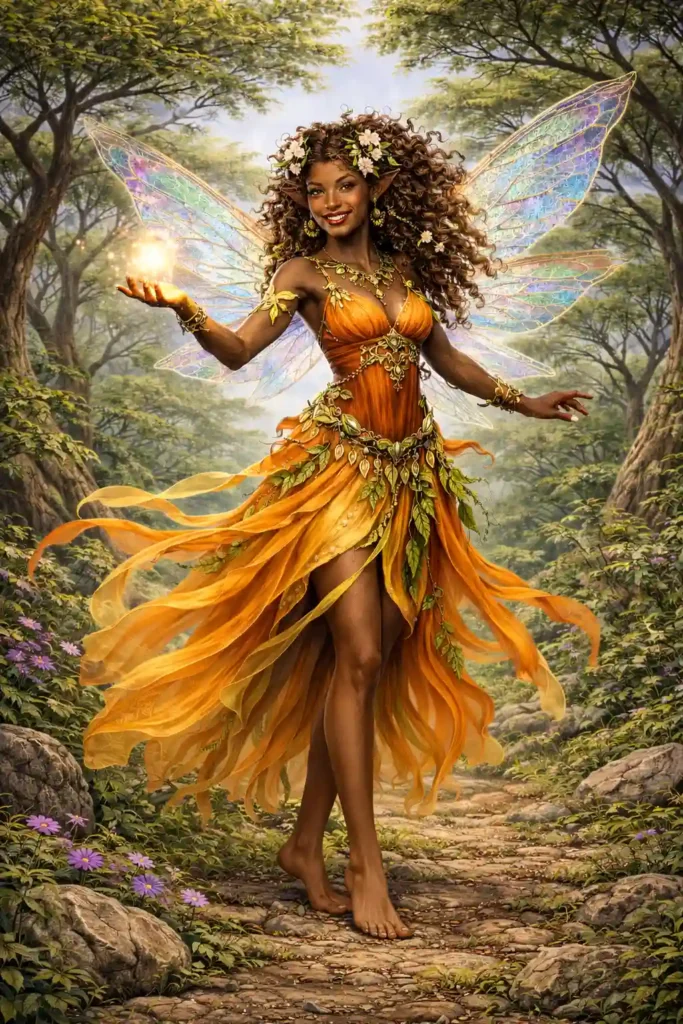
Appearance
- The Diminutive Stature: They are small, usually described as being scarcely taller than a human child, with some accounts placing them at only a few inches tall.
- The Radiant Glow: They are often seen as luminous beings, emitting a soft, magical light that can be mistaken for fireflies in the dense canopy.
- The Butterfly Wings: In many modern and post-colonial accounts, they are depicted with iridescent wings similar to Monarch or African Queen butterflies, though older oral traditions sometimes describe them as wingless "little people."
- The Bark-Etched Skin: Their skin is often a deep, rich brown or ebony, sometimes etched with intricate, swirling patterns that resemble the grain of an ancient tree.
- The Hairy Variation: In certain West African dialects, the Aziza are described as being "fuzzy" or covered in a fine layer of hair, which helps them blend into the moss and forest floor.
- The Single-Legged Avatar: In specific Jeje and Urhobo traditions, a singular divine entity also named "Aziza" appears as a small, one-legged man smoking a pipe, possessing incredible speed and wisdom..