
★ Overview
KINNARA
Kinnara is a mythical creature in Hindu and Buddhist mythology, particularly prominent in Indian and Southeast Asian folklore. It is depicted as a celestial being with the head, torso, and arms of a human and the lower body of a horse, similar to a centaur.
The Kinnara (masculine) and Kinnari (feminine) are often associated with music, dance, and poetry, and they are considered to be skilled musicians and dancers. In Hindu mythology, they are said to inhabit the Himalayas and are sometimes depicted as the companions of gods and goddesses, particularly Kubera, the god of wealth, and Gandharvas, celestial musicians. In Buddhist mythology, Kinnaras are often portrayed as heavenly beings who inhabit the realm of Tavatimsa, where they serve as celestial musicians in the court of Indra, the king of the gods.
Known for their unwavering devotion to their partners, it is said that they never part from one another; a single day of separation brings them more grief than a lifetime of hardship. They are the quintessential “gentle spirits”—they do not hunt, they do not wage war, and they spend their immortal lives singing, dancing, and playing flutes amongst the flower-laden peaks.
Origin & History
The origin of the Kinnara myth can be traced back to ancient Indian and Southeast Asian cultures, particularly within Hindu and Buddhist traditions.
In Hindu mythology, the concept of celestial beings with both human and animal attributes has roots in Vedic literature, where various hybrid beings are mentioned.
In Buddhist mythology, Kinnaras are mentioned in texts such as the Jataka Tales, which recount the previous lives of Gautama Buddha. Here, Kinnaras are often depicted as inhabitants of the heavenly realm, associated with the god Indra and revered for their musical talents.
Powers & Abilities
- Celestial Music: Their voices are so beautiful that they can calm wild animals, stop the flow of rivers, and ease the suffering of any living being who hears them.
- Flight: With their bird-like lower halves, they can fly between the mountain peaks and the lower heavens with effortless speed.
- Innate Purity: They are spirits of "Sattva" (purity). They are incapable of deceit or malice, making them the favorite companions of the gods and sages.
- Auspicious Presence: To see a Kinnara is a sign of peace and artistic inspiration. They are often depicted guarding the entrances to sacred temples.
Appearance
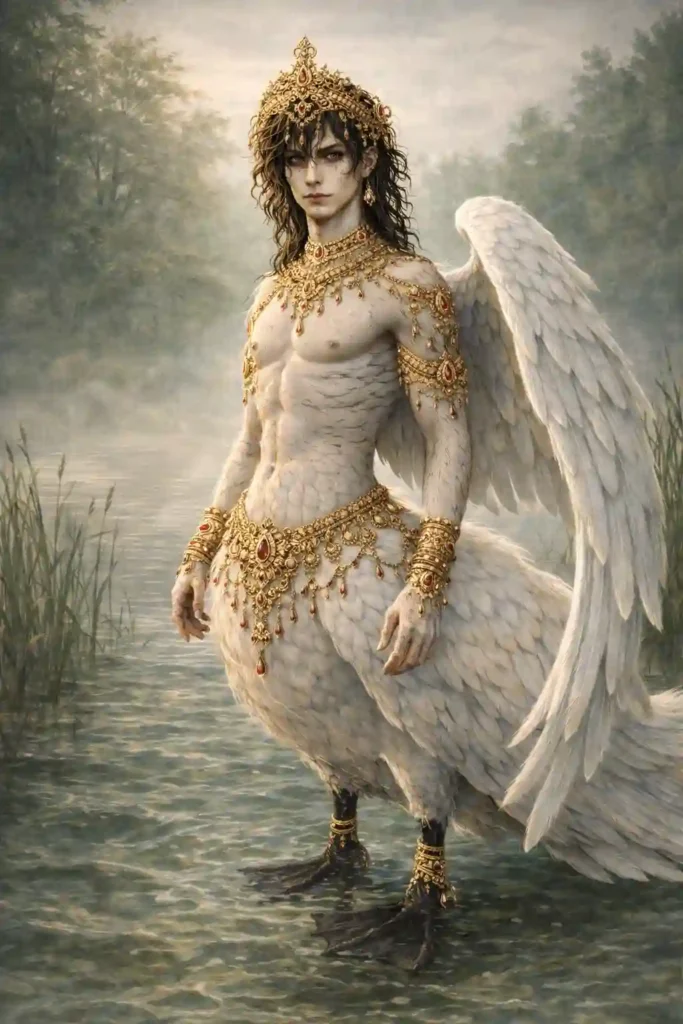
- The Hybrid Form: Their most famous depiction is that of a human upper body and the lower body, wings, and tail of a swan or bird.
- The Avian Details: In Southeast Asian art, their bird-halves are incredibly ornate, featuring golden scales and sweeping, colorful tail feathers.
- The Human Elegance: From the waist up, they are beautiful humans, often wearing crowns or floral wreaths and playing musical instruments like the lute or flute.
- The Horse-Headed Variant: In earlier Indian (Vedic) texts, Kinnaras were sometimes described as having a human body with the head of a horse, though the bird-human hybrid became the dominant image over time.
- The Weightless Grace: They are often shown perched on tree branches or hovering above lotus ponds, their movements so light they barely disturb the air.