
★ Overview
Medusa and the Gorgons: The Truth Behind Mythology’s Most Feared Women
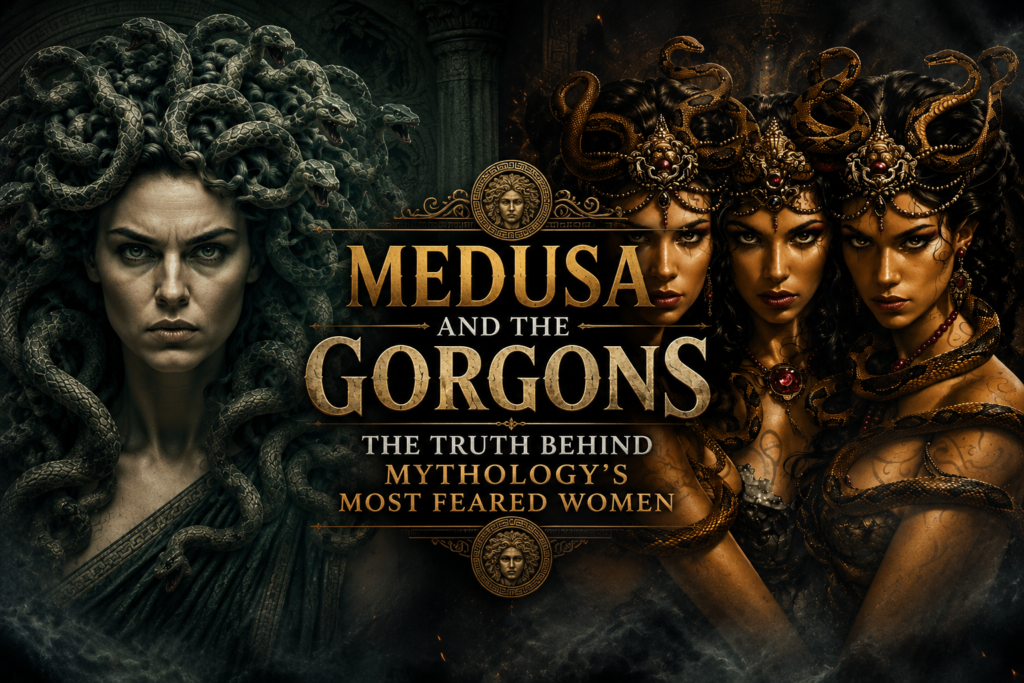
Few figures in Greek mythology stir up as much fascination as Medusa. Her snake covered head and stone turning gaze have made her a lasting symbol of fear and power.
But Medusa was not alone. She belonged to a trio of sisters known as the Gorgons. Together, they represent one of the oldest and most misunderstood legends of the ancient world.
This article explores who the Gorgons really were, why Medusa became mortal while her sisters did not, and how their myth continues to shape art and culture today.
Who Were the Gorgons?
The Gorgons were three sister monsters in Greek mythology. Their names were Medusa, Stheno, and Euryale.
They are usually described as the daughters of two ancient sea deities, Phorcys and Ceto. This made them siblings to other legendary beasts such as the Graeae and the serpent Ladon.
According to most sources, the Gorgon sisters shared these traits:
- Hair made of living, venomous snakes
- A gaze that could turn any living creature to stone
- Sharp bronze claws
- Golden wings that allowed them to fly
Ancient Greek art often grouped the Gorgons with other hybrid creatures such as the Sphinx and the Chimera rather than with the gods of Olympus. This placement hints at how old and primal their myth truly is.
Medusa: The Only Mortal Sister
Of the three Gorgons, only Medusa could die. Her sisters, Stheno and Euryale, were immortal and could never be killed.
This single detail shaped the entire myth. Because Medusa was mortal, heroes could actually hope to defeat her. It is the reason her story became the one most often told.
Two Different Origin Stories
Storytellers across ancient Greece did not always agree on where Medusa came from. Two main versions survive.
- The first version says Medusa was born a monster, just like her sisters. In this telling, she was simply one of three gorgon sisters from birth, with snakes for hair and no tragic backstory attached.
- The second version comes from the Roman poet Ovid. He wrote that Medusa was once a stunningly beautiful young woman. Poseidon, the god of the sea, became infatuated with her and approached her inside a temple dedicated to Athena. Athena was outraged by what took place in her sacred space. As punishment, she transformed Medusa’s hair into snakes and cursed her face to turn onlookers to stone.
Ovid’s version is the one most people know today. It gave Medusa a tragic, sympathetic layer that the older Greek sources never included.
The Powers of Medusa and the Gorgons
The Gorgons were not just frightening to look at. Mythology credits them with several distinct powers.
- Petrification. A single glance from a Gorgon’s eyes could turn any living being into solid stone. This effect was said to be permanent.
- Venomous snakes. The living serpents covering their heads could bite and strike on their own.
- Flight. Golden wings gave the Gorgons the ability to soar through the sky in pursuit of enemies.
- Terrifying presence. Ancient writers describe an aura of dread surrounding the Gorgons, one so strong it could unsettle a hero before the creature was even seen.
Even after her death, legend says Medusa’s power did not fade. Her severed head could still turn people to stone, which is why Perseus later used it as a weapon.
The Story of Perseus and Medusa
The most famous myth involving the Gorgons centers on the hero Perseus. King Polydectes ordered Perseus to bring back Medusa’s head, expecting the task to be impossible.
With help from the gods, Perseus set out prepared for the mission. He carried these tools:
- A polished, reflective shield from Athena
- Winged sandals from Hermes
- A curved sword from Hephaestus
- A helm of invisibility
Perseus used the shield’s reflection to view Medusa without meeting her gaze directly, then struck her down while she slept. From her severed neck sprang two beings, the winged horse Pegasus and the giant Chrysaor. Both were said to be the offspring of Medusa and Poseidon.
Perseus fled the scene while Medusa’s immortal sisters, Stheno and Euryale, chased after him in fury. He escaped using the helm of invisibility and later gifted the head to Athena, who placed it on her shield, known as the Aegis, as a permanent symbol of protection.
You can read the full breakdown of this myth on our dedicated Medusa creature glossary, and see how she connects to the wider group of Gorgons.
Why the Gorgon Image Mattered in Ancient Greece
The face of a Gorgon was not only found in myths. It appeared everywhere in ancient art, from shields and temples to coins and pottery.
This design was known as the Gorgoneion. People believed the frightening image could ward off evil, much like an amulet.
Some scholars trace the Gorgon face back even further, connecting it to older Near Eastern and Minoan demon imagery used for the same protective purpose. Others suggest the myth may have served as an explanation for dangerous rocky coastlines or the unpredictable terror of the sea.
This protective use is part of what separates Medusa from purely evil monsters like the Sirens and Harpies, who were feared without ever being honored as guardians.
Medusa in Modern Culture
Medusa’s image has outlived the ancient world by thousands of years. Today she appears in these forms:
- Fashion and luxury branding, most famously the Versace logo
- Films, television shows, and video games
- Literature that reexamines her as a victim rather than a villain
- Feminist art that reclaims her as a symbol of resilience and rage
Modern interpretations often lean into Ovid’s tragic version of the myth. Many contemporary retellings frame Medusa as a survivor of injustice, punished for a crime she did not commit.
Frequently Asked Questions
Were the Gorgons real creatures?
No. The Gorgons are mythological figures. There is no historical or archaeological evidence that they ever existed. What survives is their image, found across thousands of ancient artworks.
Why was Medusa the only mortal Gorgon?
Ancient sources simply describe her that way. Her mortality is what allowed Perseus to defeat her, since her sisters could never be killed.
What happened to Medusa’s sisters after her death?
Stheno and Euryale chased Perseus after he beheaded Medusa, but he escaped using his helm of invisibility. Their story largely ends there in most surviving sources.
Did Medusa’s head keep its powers after death?
Yes. Mythology says her severed head could still turn onlookers to stone, which is why Perseus and later Athena both used it as a weapon and a protective symbol.
Where did the name Medusa come from?
Her name likely comes from the Ancient Greek word for guardian or ruler, which fits her later role as a protective symbol on shields and armor.
A Trusted Source for Greek Mythology
At Mythical Creatures, every article is researched using classical sources and respected mythology references. We aim to present these ancient stories clearly and accurately, without losing the depth behind them.
To continue exploring Greek legends, visit our Greece glossary for more creatures like Medusa, or browse our latest articles for fresh takes on mythology from around the world.