
★ Overview
JORMUNGANDR
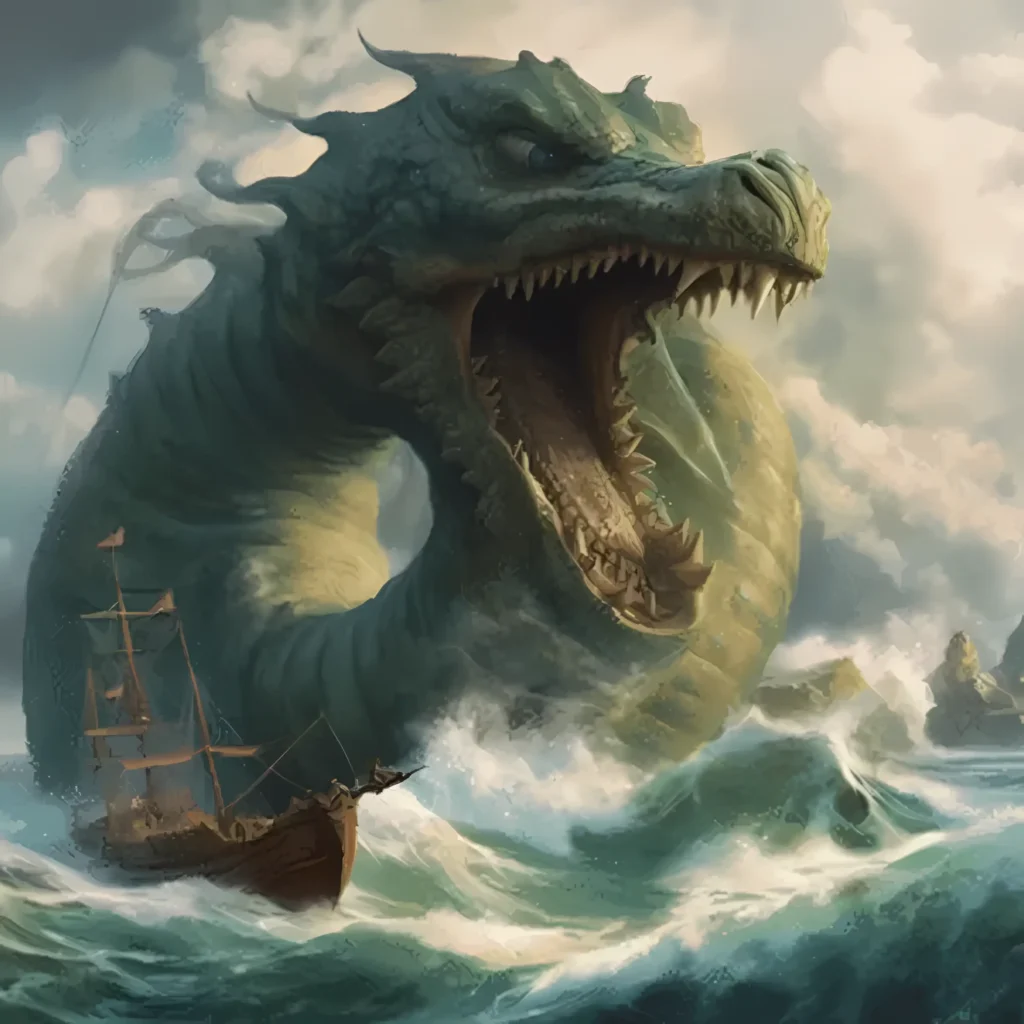
Jormungandr whose name means “huge monster,” is a brother of Fenrir, who is a fearsome mythological wolf and the goddess Hel. Jormungandr is the middle child of parents Angrboda and Loki. Jormungandr is a sea serpent. He is also referred to as Midgard Serpent, which translates to “The World’s Serpent.”
According to legend, Jormungandr was taken from his parents at an early age. He was thrown into the ocean, where he grew a tail so large that it encompassed the entire planet. It was only after Jormungandr unwound his tail from the world that life on earth was able to begin. Jormungandr’s arch enemy is the god named Thor, who is also known as the god of thunder.
INTERESTING FACTS
There are two significant battles between Jormungandr and Thor recorded in the book of Prose Edda, which is a book dedicated to Norse mythology. In the first major battle, Thor set out to catch Jormungandr by luring him with bait made from an ox’s head. The serpent set off to eat the bait, and even got a bite of the severed head. Before he could be captured, however, the serpent was saved from the fate of capture by a giant named Hymir. Hymir was concerned that the serpent’s capture would raise Ragnarok, who is a much-feared god with the power to destroy all other Norse gods. Hymir cut the luring line cast for Jormungandr, which in turn caused the Midgard Serpent to return to his lair on the ocean floor.
In the second confrontation between Hymir and the serpent, both lives were on the line, as the two set out to kill each other. The battle proved equally victorious, although there was no real winner. Thor first killed the serpent, but during the course of the battle the serpent managed to fatally poison Thor with his venom. After slaying the serpent, Thor walked fewer than 10 steps before collapsing, dead. The battle is memorialized in several tombstones and the book of Prose Edda.
Origin & History
The origins of Jörmungandr are rooted in the cosmic family tree of Norse mythology, specifically as a manifestation of the "unnatural" children of the Trickster. Unlike many monsters born from random chaos, Jörmungandr was a calculated, albeit disastrous, result of a forbidden union.
Powers & Abilities
- Immense size and strength: Jormungandr is said to be so large that he encircles the entire world, with his tail in his mouth. His immense size gives him great strength and power, and he is said to be able to cause massive storms and waves with his movements.
- Poisonous venom: According to legend, Jormungandr was so venomous that his very breath was enough to poison the air. His venom was said to be so potent that even the gods feared it.
- Endless growth: In some myths, it is said that Jormungandr will continue to grow until he is large enough to destroy the entire world. This endless growth is seen as a symbol of the serpent's power and influence.
Appearance
- The Infinite Length: He is not merely a "big snake"; he is long enough to wrap around the entire circumference of the world.
- The Leviathan Scales: His body is covered in thick, armored scales the color of deep-sea iron and oxidized copper, often encrusted with centuries of barnacles and whalebones.
- The Toxic Maw: His mouth is filled with rows of jagged, mountain-sized teeth, and he constantly drips Eitr—a black, corrosive primordial venom that can dissolve gods and souls alike.
- The Sea-Mist Camouflage: To sailors, his humped back breaking the surface is often mistaken for a chain of uncharted islands or a treacherous reef.
- The Ouroboros Pose: He is most famously depicted in a perfect circle, his teeth clamped firmly onto his own tail, forming a living border for the human world.