
★ Overview
10 Mythical Creatures That Refuse to Stay in Folklore
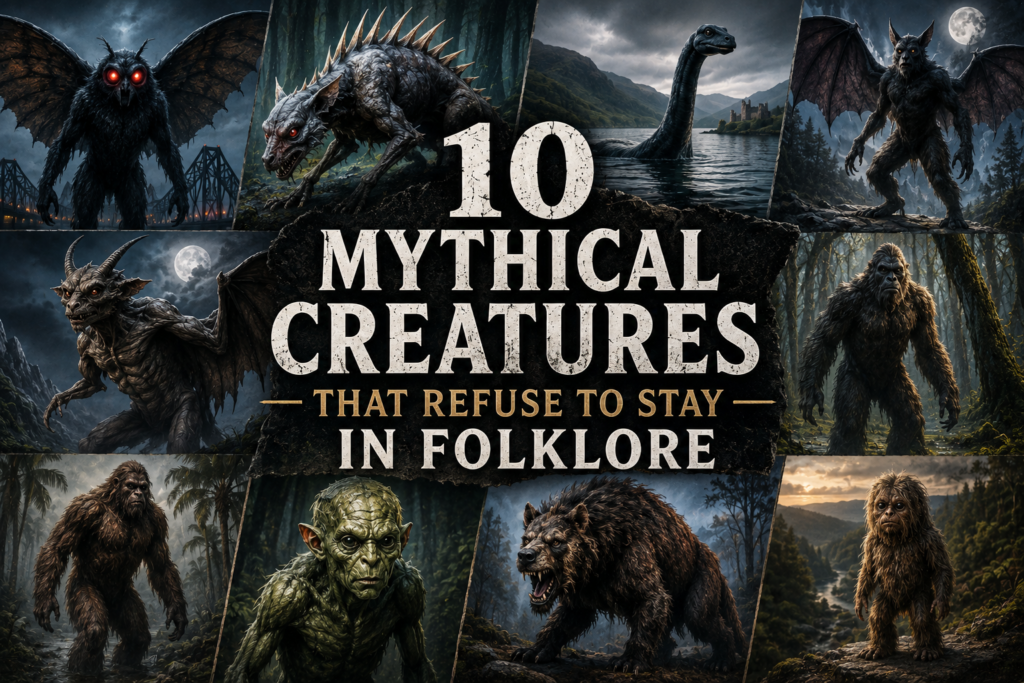
Most legends fade quietly into old books. They did not get the memo.
Across forests, swamps, and lake waters, people keep reporting encounters with creatures that were supposedly confined to campfire stories generations ago. New sightings still surface. Festivals still celebrate them. Researchers still chase them with cameras and recorders.
This list rounds up ten mythical creatures that simply will not stay in the past. Each one comes straight from our own glossary of modern cryptids and folklore legends.
1. Mothman
Few cryptids feel as eerie as Mothman. This creature is native to West Virginia and has been described as both a terrifying flying monster and a strange, supernatural omen of disaster.
The Mothman creature’s sightings famously preceded the 1967 Silver Bridge collapse. Reports of the creature reportedly resurfaced again before a 1999 apartment fire in Russia.
Witnesses commonly describe a few chilling traits.
- Glowing red eyes that can supposedly paralyze onlookers with fear
- The ability to keep pace with cars traveling over 100 miles per hour
- A lingering feeling of being watched after an encounter
Point Pleasant, West Virginia still holds an annual Mothman Festival, proof that this legend has not lost its grip on public fascination.
2. Chupacabra
The Chupacabra earned its name from a Spanish phrase meaning goat sucker, based on its alleged habit of draining livestock of blood.
The Chupacabra traces sightings back to Puerto Rico in 1996, with reports later spreading to the mainland United States and Mexico. Sightings have even reached as far north as Oregon and Pennsylvania.
Descriptions of the creature generally fall into two categories.
- A bipedal version with reptilian skin, glowing red eyes, and spikes running down its back
- A four legged, hairless canine type often nicknamed the Blue Dog
Both versions share long, needle-like fangs, and witnesses often report a strong smell of sulfur following an encounter.
3. Loch Ness Monster
Nessie is arguably the most famous cryptid in the world. The Loch Ness Monster creature, one of the earliest known sightings, dates back to a biography of St. Columba in 565 AD.
The modern legend truly took off in the 1930s, after a sighting by George Spicer was later supported by photographs and a widely circulated sketch.
A few facts explain why the legend refuses to die.
- Loch Ness is about 23 miles long and reaches depths of roughly 230 meters
- Multiple sonar expeditions since the 1960s have returned unexplained large readings
- The legend reportedly adds around 51 million dollars to Scotland’s tourism economy each year
The sheer size and depth of the loch make it nearly impossible to rule the creature out entirely, which keeps both believers and skeptics endlessly engaged.
4. Jersey Devil
New Jersey’s most famous legend has been terrifying residents for centuries. According to early accounts from the late 1700s and 1800s, the Jersey Devil was said to be completely immune to cannonball fire.
In 1909, hundreds of newspaper reports about the Jersey Devil appeared within a short span of time. One account even claimed the creature attacked a trolley car and shrugged off gunfire entirely.
Modern encounters tend to follow a consistent pattern.
- Brief, fleeting sightings rather than prolonged encounters
- A distinctive scream before the creature flies away
- No supernatural powers reported, despite its fearsome reputation
People continue hunting for solid evidence of the Jersey Devil today, though nothing conclusive has ever surfaced.
5. Skunk Ape
Florida’s swampy Everglades hide their own regional Bigfoot. The Skunk Ape creature is a large primate closely related to Bigfoot, but with a few notable differences.
Key details from reported sightings include the following.
- Reddish fur, unlike Bigfoot’s typical brown coloring
- Longer patches of fur on the shoulders and arms, similar to an orangutan
- A strong, unpleasant odor that gives the creature its name
Decades of reports from southern residents have kept the Skunk Ape firmly rooted in regional folklore.
6. Owlman
Cornwall, England has its own winged mystery. The Owlman creature is often compared to Bigfoot and the Loch Ness Monster as a modern cryptid rather than an ancient myth.
Reported abilities include the following.
- Flight, aided by large wings
- Exceptional stealth and camouflage in its surroundings
- Night vision, with glowing red or orange eyes said to pierce the darkness
Some researchers suggest the legend may stem from misidentified owls or herons, yet sightings have continued to circulate for decades.
7. Grassman
Ohio has its own version of Bigfoot roaming the Shawnee Forest and Appalachian Mountains. Grassman creature is a large, ape-like humanoid similar to Sasquatch, but with distinct regional traits.
Reported characteristics include the following.
- A body covered in shaggy, dark colored fur
- A large, muscular build standing between six and nine feet tall
- A bipedal, humanoid stance
The Grassman legend continues to draw cryptid hunters into the Ohio wilderness looking for footprints and evidence.
8. Nandi Bear
Kenya’s high forests hold a much more aggressive cryptid. Nandi Bear creature is sometimes called chemosit, meaning demon in the Kalenjin language.
Some cryptozoologists theorize connections to extinct species.
- A possible remnant of the chalicothere, a clawed herbivore
- A potential surviving relative of Pachycrocuta, a giant extinct hyena
To the Nandi people, the creature has long been considered a devil that haunts the elevated forest terrain, and stories about it continue to circulate today.
9. Batsquatch
Washington State’s Mount St. Helens has its own hybrid legend. Batsquatch is a creature combining traits of a bat and a Sasquatch.
Common features reported by witnesses include the following.
- A humanoid body covered in fur or hair
- Large, bat like wings that allow it to fly
- A general resemblance to both bat and Bigfoot type cryptids
This unusual combination makes Batsquatch one of the more distinctive entries on any modern cryptid list.
10. Albatwitch
Pennsylvania’s Chickies Rock area is home to a much smaller cryptid. Albatwitch creature resembles a miniature Bigfoot standing around four feet tall.
Notable traits include the following.
- A small, humanoid build resembling a scaled down Sasquatch
- Arms, legs, and a torso similar in proportion to a human
- Inconsistent reports regarding fur or hair covering
Though sightings remain rare, the Albatwitch has become a lasting part of local Pennsylvania folklore.
Why These Legends Keep Coming Back
A few common threads connect every creature on this list.
- Isolated habitats. Dense forests, deep lakes, and remote mountains make it nearly impossible to fully rule these creatures out.
- Consistent witness reports. Many sightings share strikingly similar details across decades and even different regions.
- Cultural momentum. Festivals, museums, and tourism keep these legends alive in the public imagination.
- Genuine scientific mystery. Remote habitats occasionally do reveal previously undocumented species, which keeps hope alive for believers.
Whether or not any of these creatures are ever proven real, their staying power says something fascinating about human curiosity itself.
Frequently Asked Questions
What is the difference between a mythical creature and a cryptid?
A cryptid generally refers to a creature reportedly sighted in modern times, while a mythical creature typically comes from older, established folklore and mythology.
Has any cryptid on this list ever been proven real?
No. None of these creatures have been scientifically confirmed. Sightings remain anecdotal, based on witness testimony and occasional photographs or footprints.
Why do sightings of these creatures continue in modern times?
Remote habitats, cultural traditions, and a genuine sense of mystery all help keep interest and reported sightings alive across generations.
Which of these creatures is considered the most famous?
The Loch Ness Monster is widely regarded as the most globally recognized cryptid, with sightings dating back centuries and a massive tourism industry built around the legend.
Are any of these creatures dangerous according to folklore?
Some, like the Chupacabra and Nandi Bear, are associated with livestock attacks or aggressive behavior. Others, such as the Jersey Devil, are mostly known for fleeting, non violent encounters.
A Trusted Source for Cryptid Research
At Mythical Creatures, every glossary entry is researched using consistent folklore records, regional accounts, and documented sighting histories to keep these legends as accurate as possible.