
★ Overview
The Most Terrifying Undead Creatures
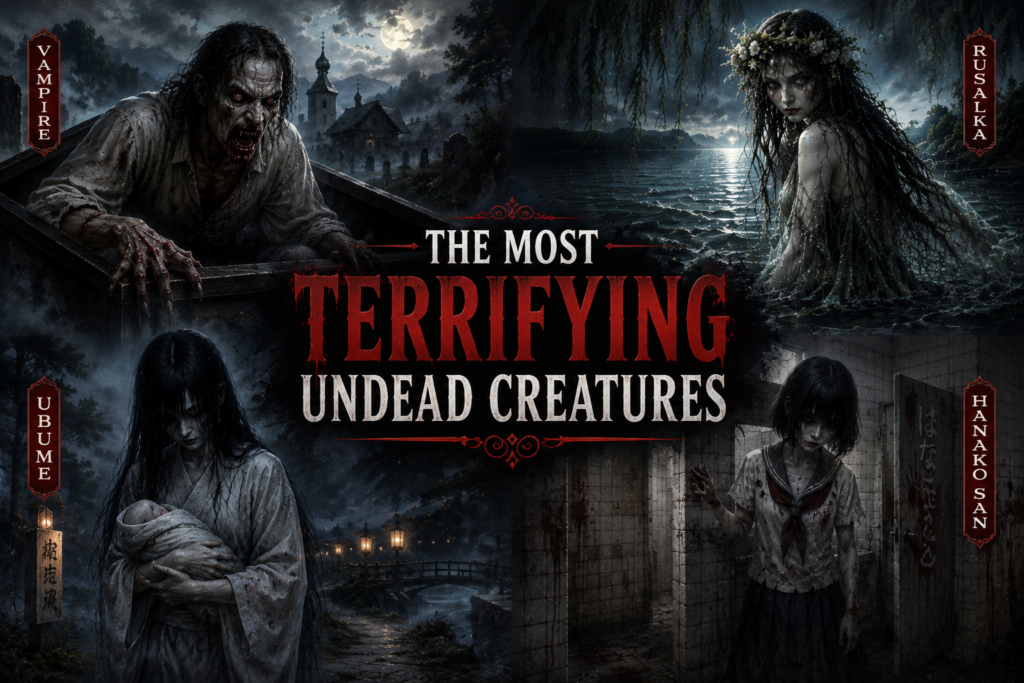
Death is supposed to be the end of the story. In mythology, it rarely is.
Across cultures, storytellers have imagined what happens when the dead refuse to stay buried. Some rise out of vengeance. Some linger out of grief. Others never truly understood that they had died at all.
Here are four of the most terrifying undead creatures in world mythology, each one still capable of sending a chill down the spine centuries later.
What Actually Makes A Creature Undead
Before diving in, it helps to define the term. Not every ghost or spirit qualifies as undead.
Generally, an undead creature meets a few conditions.
- It was once a living human being.
- It died, often under tragic, violent, or unresolved circumstances.
- It continues to exist in some physical or semi physical form after death.
- Its presence usually threatens or unsettles the living.
With that in mind, here are four legends that fit the definition perfectly, and earn every bit of their reputation.
1. The Vampire, Slavic Folklore’s Original Undead
Long before pop culture gave vampires capes and charm, Slavic folklore gave the world something far more disturbing.
The Slavic vampire was not a suave aristocrat. It was a corpse, bloated and discolored, rising from its grave to feed on the blood of the living, often targeting its own family first. Villages took the threat seriously, staking suspected corpses, burying them face down, or placing objects in the grave to trap them before they could rise.
What makes the Slavic vampire genuinely terrifying is not just the blood, but the reason behind it. A person could become a vampire through a sinful life, an improper burial, or simply dying at the wrong moment, meaning almost anyone could return.
A few details still define the legend today:
- Belief in vampiric corpses predates the modern vampire genre by centuries.
- Communities developed detailed burial rituals specifically to prevent reanimation.
- The fear was communal, entire villages could become convinced a specific grave was active.
2. Rusalka, The Drowned Spirit Who Never Left The Water
Not every undead spirit crawls from a grave. Some rise from the water instead.
The Rusalka is the restless spirit of a young woman who died before her time, most often drowned in a river or lake. Unlike a typical ghost, she remains physically tied to the water that claimed her, appearing at night to sing, dance, and comb her hair on the riverbank.
Her voice is her weapon. Travelers who hear her singing, particularly young men walking too close to the water after dark, are drawn toward the sound and pulled beneath the surface, becoming part of the tragedy that created her in the first place.
What sets Rusalka apart from other undead legends is her tragic origin. She is rarely portrayed as purely evil, but as a victim whose death transformed her into something that now, often unintentionally, creates more victims like herself..
3. Ubume, The Ghost Who Still Carries Her Child
Japanese folklore offers one of the most heartbreaking undead legends in the form of Ubume.
Ubume is the spirit of a woman who died during childbirth, often before ever holding her baby. She appears at night on roadsides or riverbanks, looking like an ordinary woman carrying an infant. She approaches passersby and asks them to hold her child, if only for a moment.
Those who accept quickly realize something is wrong. The bundle in their arms grows unnaturally heavy, and when they finally look down, the child has become a stone or a pile of leaves. By then, Ubume has already vanished into the dark.
Ubume’s terror comes less from violence and more from unresolved grief. She is not hunting the living out of malice, but seems trapped in an endless attempt to complete a moment death stole from her.
4. Hanako San, The Schoolgirl Who Never Left
Not every undead legend comes from ancient scrolls. Some are far more recent, and far closer to home.
Hanako San is the ghost of a young girl said to haunt school bathrooms across Japan. Her origin story shifts depending on who tells it. In some versions she died during a wartime air raid. In others she was the victim of bullying or a tragic accident. What stays consistent is where she waits, the third stall of the girls’ bathroom, usually on the third floor.
According to the legend, curious students can summon her by knocking on the stall door three times and asking, “Are you there, Hanako San?” What happens next depends entirely on which version of the story is being told, and whether the person asking truly wants an answer.
Hanako San proves that undead legends do not need centuries of history to feel real. Her legend spread rapidly through Japanese schoolyards, turning an ordinary bathroom stall into one of the most quietly terrifying places a child could imagine.
Why Undead Legends Feel So Universal
Vampires, drowned spirits, grieving mothers, and schoolyard ghosts come from entirely different cultures, yet the fear they represent feels strangely familiar everywhere.
A few patterns explain why.
- Death left unfinished. Most undead legends involve a life or moment cut short, a wedding, a birth, a normal school day.
- A body without proper rest. Cultures across the world share a deep discomfort with improper burial or unresolved death.
- Grief given a shape. Many undead spirits are less about horror and more about processing loss, giving communities a way to talk about death, tragedy, and memory.
- Rules that can be broken. Almost every undead legend comes with instructions, how to summon it, how to stop it, or how to avoid it entirely, which keeps the story alive through retelling.
That combination of fear and familiarity is exactly why these legends have survived for generations.
Why Trust Our Mythology Research
Every legend on Mythical Creatures is researched from historical folklore, cultural traditions, and established written sources rather than modern pop culture retellings.
We aim to present each creature the way it actually appears in its culture of origin, including regional variations, historical context, and the reasons a community believed in it in the first place. When a legend has multiple versions, we note that rather than flattening it into a single simplified story.
Our growing Creature Glossary currently spans Slavic, Japanese, Greek, and many other traditions, with new undead and non undead entries added regularly.
Frequently Asked Questions
What is the difference between a ghost and an undead creature?
A ghost is typically a non physical presence, while an undead creature usually retains some form of physical existence after death, such as a reanimated body or a spirit tied to a specific physical form.
Why are so many undead legends female?
Many cultures used undead female spirits like Rusalka and Ubume to process the real historical dangers women faced, such as death in childbirth or drowning, giving those tragedies a lasting cultural memory.
Is the Slavic vampire the same as modern vampire fiction?
No. The original Slavic vampire was a decaying, feared corpse rather than the elegant, seductive figure popularized by later fiction and film.
Are Ubume and Hanako San considered the same type of spirit?
Not exactly. Ubume is a yōkai tied to a specific tragic circumstance, death in childbirth, while Hanako San is generally classified as a yūrei, a more modern school based urban legend ghost.
Can undead legends still be found in belief today?
Yes, in some regions. Certain undead legends, including local vampire folklore and urban legends like Hanako San, remain part of active oral tradition and popular belief.
Where can I read about more creatures like these?
Our full Creature Glossary is organized by region and continues to expand with both classic legends and newly added creatures.
Some Stories Never Truly Rest
Undead legends endure because they speak to something universal, the fear that death is not always final, and that grief, tragedy, and memory can take on a life of their own.