
★ Overview
Werewolves Through History: From Ancient Curses to Modern Cinema
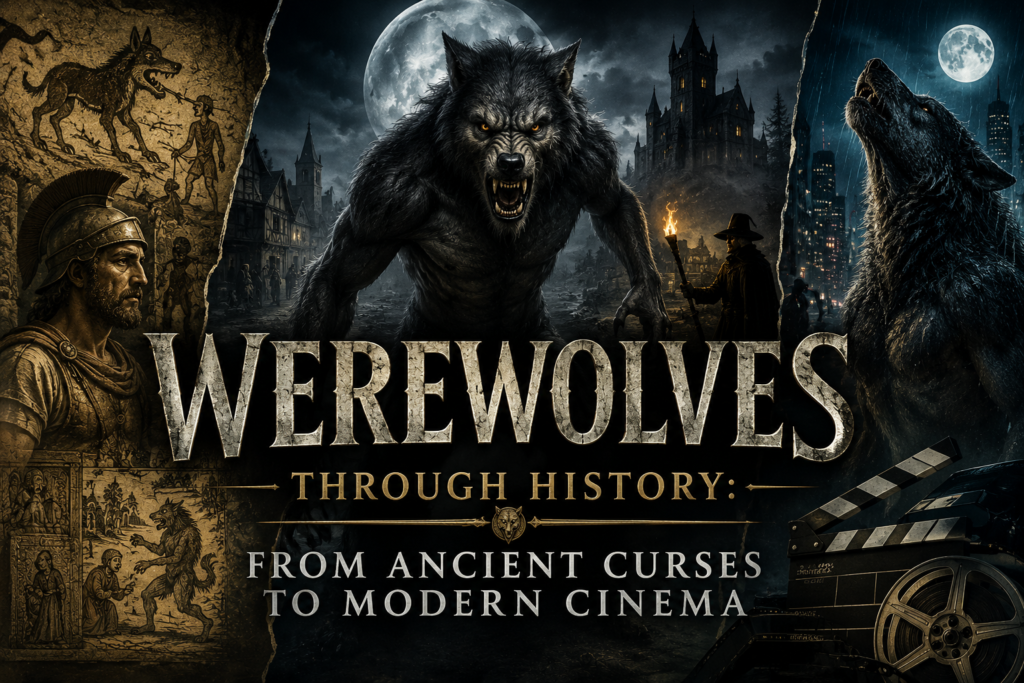
The werewolf is one of the oldest and most enduring monsters in human storytelling. A person transforms into a wolf, driven by a curse, a bite, or the pull of the full moon.
This legend has survived for thousands of years. It has shifted from ancient myth to medieval terror to a horror movie staple.
This article traces the werewolf from its earliest origins through the trials of the Middle Ages and into its modern place in film and pop culture.
What Is a Werewolf?
A werewolf, also called a lycanthrope, is a person who can shift between human and wolf form. This word comes from the Greek term for wolf man.
According to folklore, this transformation happens in a few different ways.
- Being bitten or scratched by another werewolf
- Being cursed by a god, witch, or spirit
- Wearing an enchanted wolf pelt or magical belt
- Being born under specific conditions, such as during a full moon
The full moon connection is the version most people know today, but as our own werewolf glossary entry explains, older folklore was actually far more varied than that single detail suggests.
The Ancient Origins of the Werewolf Myth
Nobody can pinpoint the exact moment the werewolf legend began. What we do know is that stories of wolf transformation stretch back to the ancient world.
Greek Mythology and King Lycaon
One of the earliest known versions of this myth comes from ancient Greece. It centers on a king named Lycaon.
According to legend, King Lycaon committed a horrific act. He sacrificed a child on an altar dedicated to Zeus. As punishment for this cruelty, Zeus transformed Lycaon and his sons into wolves.
This story is actually where the word lycanthrope comes from. It blends the Greek words for wolf and human into a single term that still describes the condition today.
Norse and Early European Legends
Wolf transformation myths were not limited to Greece. Similar stories appear in Norse mythology as well, often tied to warriors who took on wolf like ferocity in battle.
Across early Europe, wolves held a complicated place in the cultural imagination. They were feared as predators, yet also respected for their strength and pack loyalty. This tension helped fuel centuries of wolf transformation folklore.
The Werewolf Trials of the Middle Ages
The werewolf legend took a darker, more dangerous turn during the medieval period. Belief in lycanthropy stopped being just a story and became a real accusation.
In the 1500s, several people across Europe were formally tried and executed for supposedly being werewolves.
Court records from this era reveal disturbing patterns. Many accused individuals confessed under torture. Others genuinely believed the claims themselves, describing how they had transformed using specific tools.
- A magical belt given by the devil
- A special ointment or salve rubbed onto the skin
- A cursed wolf pelt worn during the transformation
These trials often overlapped with the era’s witch hunts. Fear, superstition, and social pressure combined to create a dangerous climate where an accusation alone could be a death sentence.
How Werewolves Were Described in Folklore
Old legends did not always agree on what a werewolf actually looked like or how it behaved. Still, certain traits appear again and again across different tellings.
Physical Appearance
Folklore generally describes werewolves in these terms.
- Roughly human sized, though sometimes noticeably larger
- Standing upright on two legs, though some tales describe running on four
- Covered in long hair along the arms, legs, and face
- Twisted, distorted features that hint at their human origin
- Wild, ravenous eyes
Powers and Abilities
Werewolves are consistently portrayed as far more dangerous than an ordinary wolf or human. Common abilities include the following.
- Superhuman strength capable of overpowering multiple opponents
- Enhanced speed and agility across difficult terrain
- Heightened senses of smell and hearing
- Rapid healing from wounds that would kill a normal person
- Shapeshifting, usually triggered by the full moon or intense emotion
- High resistance to physical injury
Some tellings even describe an extended lifespan or true immortality. Not every legend agrees on which powers apply, but this combination shows up again and again across cultures.
Traditional Weaknesses
Folklore also gave people ways to fight back. The most commonly cited weaknesses include the following.
- Silver, especially in weapon form
- Wolfsbane, a poisonous plant
- Exorcism or religious ritual
Werewolf Legends Around the World
While the werewolf is generally remembered as a European legend, similar shapeshifting figures appear in folklore across the globe.
One well known regional variation is the Rougarou, a creature from Cajun folklore in Louisiana. According to our Rougarou creature, this legend developed from French werewolf folklore brought over by early settlers, later blending with local Cajun culture.
The Rougarou legend includes its own unique details.
- Its curse spreads through a bite or scratch, giving the victim 101 days before transformation
- It moves through marshland faster than a boat
- It retains human intelligence and can recognize people from its former life
This regional variation shows how the core werewolf myth adapted as it traveled, taking on the landscape and beliefs of each new culture.
The Werewolf in Modern Cinema
By the twentieth century, the werewolf had shifted from a genuine folk terror into a fixture of horror entertainment. The film gave the legend a whole new life.
Modern cinema tends to lean on a few consistent elements.
- Transformation triggered by the full moon
- A painful, often graphic physical change from human to wolf
- A curse passed on through a bite
- Silver as the definitive weakness
These film conventions do not always match older folklore exactly, but they have become the version most audiences recognize today. Decades of movies have cemented the full moon and silver bullet as the defining rules of the myth.
Unlike the vampire, who is often shown as calculated and refined, the werewolf remains a symbol of raw, uncontrolled violence. Many stories frame it as a human soul trapped inside a body built only for the hunt.
Symbolism Behind the Werewolf Myth
Beyond the fear factor, werewolf stories tend to explore deeper themes. A few recurring ideas include the following.
- Duality. The struggle between civilized humanity and primal instinct.
- Loss of control. Fear of one’s own body or mind turning against them.
- Lunar cycles. A connection to nature’s rhythms and forces beyond human control.
These themes are part of why the myth has lasted so long. It taps into something universal about fear of change and fear of the self.
Frequently Asked Questions
What is the origin of the word werewolf?
The word lycanthrope comes from the Greek myth of King Lycaon, who was transformed into a wolf by Zeus as punishment for his cruelty.
Is the full moon transformation part of original folklore?
Not always. Many historical legends describe other transformation triggers, such as magical belts, cursed ointments, or wolf pelts. The full moon became the dominant version mostly through modern storytelling.
Were people really put on trial for being werewolves?
Yes. In the 1500s, courts in parts of Europe tried and executed individuals accused of lycanthropy, often during the same period as witch hunts.
What is the difference between a werewolf and a Rougarou?
The Rougarou is a regional variation of the werewolf myth from Cajun Louisiana folklore. It shares core traits like transformation and a spreading curse, but includes unique details such as a 101 day incubation period.
What are the traditional weaknesses of a werewolf?
Folklore most commonly points to silver, wolfsbane, and exorcism as ways to weaken or cure a werewolf.
A Trusted Source for Mythical Creature Research
At Mythical Creatures, every article draws on established folklore records and historical accounts to keep the legends as accurate as possible.
To keep exploring shapeshifter mythology, visit our creature glossary or read more origin stories on our articles page.