★ Overview
The Strangest Mythical Creatures You Have Never Heard of
Everyone knows Medusa. Everyone knows the Minotaur. But mythology runs far deeper than the household names.
Tucked into old texts, folk tales, and regional legends are creatures so strange they barely sound real, even by mythology’s standards. Some are tragic. Some are terrifying. All of them deserve far more attention than they get.
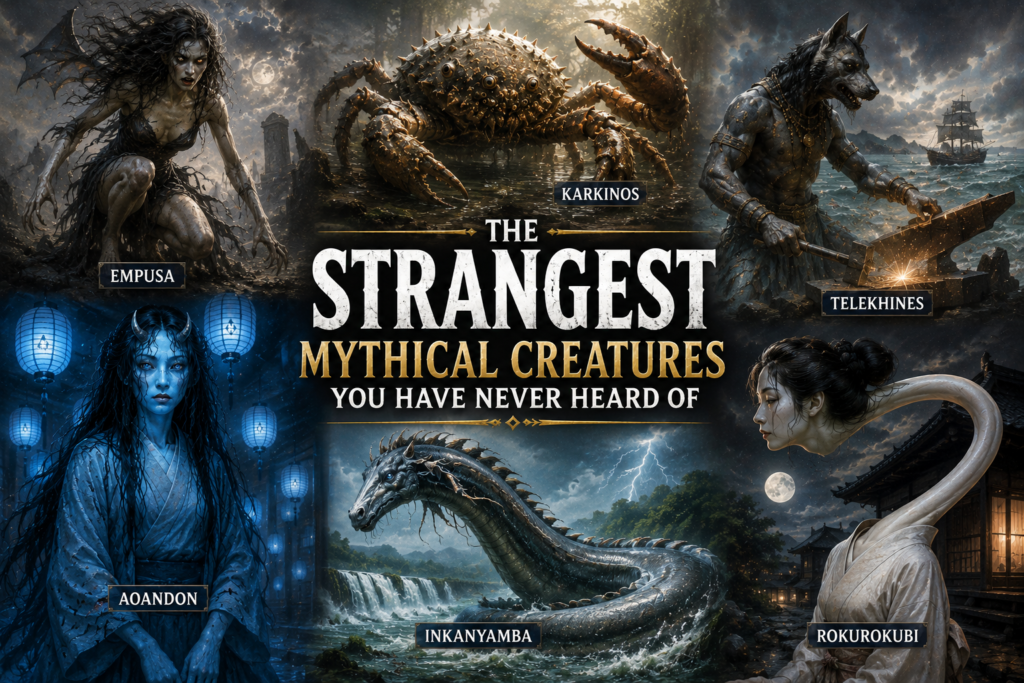
Here are six of the strangest mythical creatures you have probably never heard of.
1. Empusa, The One Legged Shape Shifter Of Greece
Greek mythology gave us plenty of monsters, but few are as bizarre as Empusa.
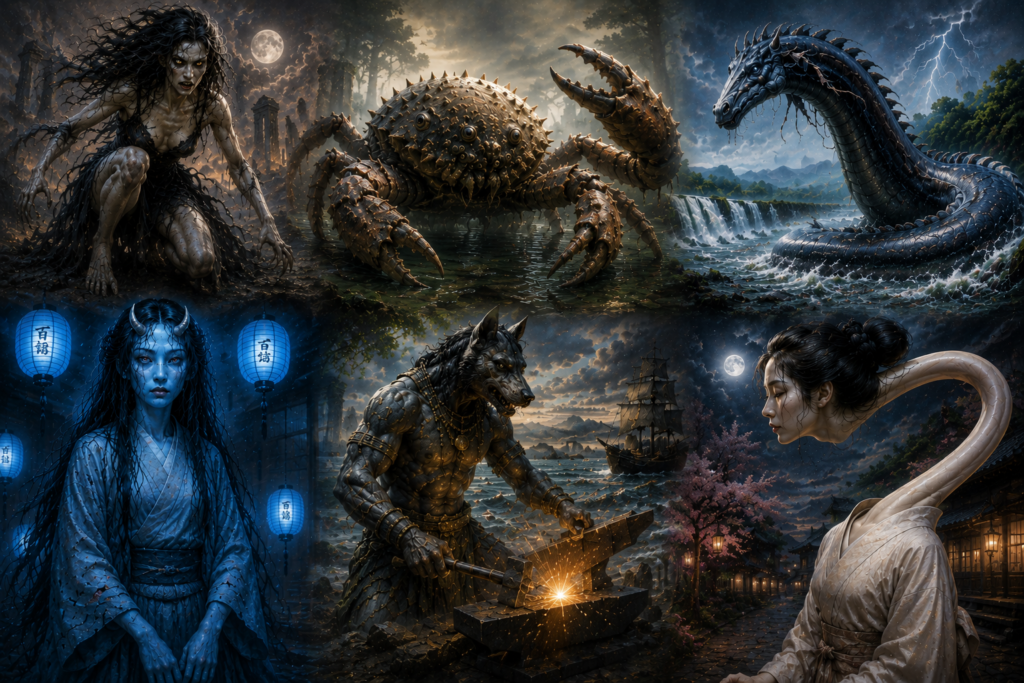
Empusa was a shape shifting demon commanded by Hecate, the goddess of magic and the night. She could appear as almost anything, a beautiful woman, a cow, a dog, or a blur of fire, but one detail always gave her away. Beneath whatever form she wore, one of her legs was made of bronze, and in some versions, the other ended in a donkey’s hoof.
Ancient writers described her preying on young men, luring them with beauty before draining their blood and flesh. She appears in the works of the playwright Aristophanes, where characters panic at the mere thought of encountering her on a dark road.
A few details make Empusa especially strange:
- She could change form mid conversation, without warning.
- Her mismatched legs were said to be the only way to expose her true nature.
- She was closely associated with crossroads and burial sites, places believed to attract restless spirits.
2. Karkinos, The Giant Crab That Fought A Hero
Not every monster in Greek mythology was a serpent or a beast with fangs. Some were simply crabs, just enormous ones.
Karkinos was a giant crab that lived in the marshes of Lerna, the same swampland home to the monstrous Hydra. When the goddess Hera saw the hero Heracles struggling against the Hydra during his famous labors, she sent Karkinos to make things worse, ordering it to clamp onto his foot mid battle.
Heracles crushed the crab without much difficulty, but Hera was not finished. Grateful for its loyalty, she placed Karkinos among the stars, where it remains today as the constellation Cancer.
What makes this creature genuinely strange is not its power, since it barely slowed the hero down, but the fact that ancient storytellers chose a crab as a divine reward worthy of the night sky.
3. The Telekhines, Dog Headed Sorcerers Of The Sea
Long before Greek mythology settled into its familiar cast of gods and monsters, an older and stranger race was said to inhabit the island of Rhodes.
The Telekhines were sea born beings with the heads of dogs and flippers in place of hands. Despite their unsettling appearance, they were known as gifted craftsmen, said to have forged early weapons and tools using magic tied to the sea itself.
Their reputation soured over time. Later myths accused them of practicing dark magic and casting the evil eye, and most versions of their story end with the gods destroying them for their arrogance and cruelty.
A few details set the Telekhines apart from typical Greek monsters:
- They were skilled metalworkers, not simple brutes.
- Their exact origin story changes dramatically between ancient sources.
- Some accounts link them to Poseidon himself as caretakers of his infant form.
4. Rokurokubi, The Woman Whose Neck Never Stops
Japan’s yokai tradition is full of strange transformations, but few are as unsettling as the Rokurokubi.
By day, a Rokurokubi looks like an ordinary woman, indistinguishable from anyone else in the village. By night, everything changes. Her neck stretches to impossible lengths, allowing her head to drift through the darkness on its own, peering through windows or licking spilled lamp oil while her body lies asleep.
A closely related variant, the Nukekubi, takes this even further. Instead of stretching, the head detaches completely and floats freely until dawn, when it must return to the body before sunrise.
Japanese folklore often describes the Rokurokubi as a curse rather than a natural state, sometimes passed down through families or triggered by a hidden sin. The woman herself is frequently unaware of what she becomes each night.
5. Aoandon, The Spirit Born From A Ghost Story Game
Some creatures are not born from ancient religion but from a game.
During the Edo period, Japanese gatherings often played Hyakumonogatari Kaidankai, a ritual where guests took turns telling one hundred ghost stories by candlelight. After each tale, one of one hundred blue paper lanterns was extinguished, and the room grew darker with every story told.
Tradition warned that when the final lantern was snuffed out, a real spirit would appear. That spirit was Aoandon, depicted as a woman with pale blue skin, sharp teeth, and small horns rising from her forehead, standing in the near total darkness of the final flame.
What makes Aoandon so strange is her origin. She was not passed down from ancient myth but essentially summoned into folklore by a parlour game, becoming real enough in the popular imagination that many simply stopped playing the game before the hundredth story could be told.
6. Inkanyamba, The Serpent Behind The Storm
Not every mythical creature lives in a forest or a cave. Inkanyamba lives inside the weather itself.
In Zulu and Xhosa tradition, Inkanyamba is described as an enormous, eel-like serpent with the head of a horse, said to dwell in deep pools beneath waterfalls, particularly the pool at Howick Falls in South Africa. Its name translates roughly to serpent of the sky, a direct reference to the tornadoes and violent storms it is believed to cause.
Locals describe Inkanyamba as deeply temperamental. When disturbed or disrespected, it is said to summon winds strong enough to tear roofs from homes and uproot trees. Some traditional healers still leave offerings near its waterfall home during storm season, hoping to keep it calm.
Unlike many mythical creatures confined to old texts, belief in Inkanyamba remains genuinely active in parts of South Africa today, making it one of the more living legends on this list.
Why These Creatures Stayed Hidden
If these six are so fascinating, why have most people never heard of them?
A few reasons explain it.
- Limited translation. Many original sources were never widely translated into English, keeping the stories confined to their home regions.
- Overshadowed by famous names. A handful of iconic monsters, like Medusa or the Minotaur, dominate popular culture and crowd out lesser known figures.
- Regional storytelling. Creatures like Inkanyamba and the Telekhines stayed largely local, passed through oral tradition rather than widely published texts.
- Modern media gaps. Movies, games, and books tend to recycle the same handful of monsters, leaving hundreds of equally strange creatures unused.
That is exactly why glossaries like this one exist, to bring lesser known legends back into the light.
Frequently Asked Questions
What makes a mythical creature obscure?
A creature is generally considered obscure when it appears in limited historical sources, was never widely translated, or was overshadowed by more famous myths from the same culture or region.
Are these creatures still believed in today?
Some are treated purely as folklore, while others, like Inkanyamba, remain part of active local belief in the regions where their legends originated.
Where do these stories come from?
These legends come from ancient texts, regional oral tradition, and cultural folklore specific to each creature’s country of origin, including Greek mythology, Japanese yokai tradition, and Zulu and Xhosa storytelling.
Why are so many yokai creatures based on ordinary humans?
Japanese yokai often represent human traits taken to an unnatural extreme, such as greed, sin, or curiosity, making creatures like Rokurokubi feel unsettling because they begin as something familiar.
Is Karkinos related to the zodiac sign Cancer?
Yes. According to Greek mythology, Hera placed Karkinos among the stars after its death, and this constellation became the origin of the zodiac sign Cancer.
Can I find more creatures like these?
Yes. Our full Creature Glossary is organized by region and continues to grow with new entries covering both famous and lesser known legends.
Keep Exploring The Unknown
Mythology is far bigger than the handful of names most people grow up knowing. Every region on earth has its own strange, unsettling, and unforgettable creatures waiting to be rediscovered.