
★ Overview
Cerberus vs. Fenrir: Which Beast Reigns Supreme in Mythology?
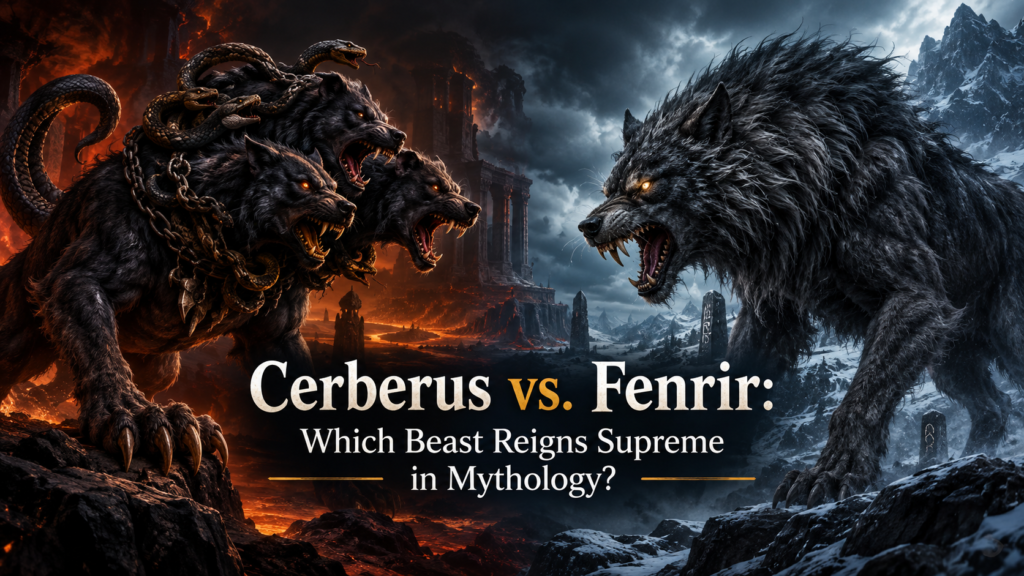
Two cultures. Two monstrous animals. Two very different kinds of terror.
Cerberus, the three headed guard dog of the Greek underworld, and Fenrir, the god killing wolf of Norse legend, both came from monstrous parents and both were feared enough that entire stories were built around containing them.
But they are not the same kind of threat. One is an unbeatable guardian. The other is a growing catastrophe waiting to happen.
Meet Cerberus, Guardian of the Underworld
Cerberus is the child of Typhon and Echidna, a pairing that also produced the Chimera and the Gorgons. His job in Greek mythology was straightforward. Guard the gates of the underworld and make sure nothing living gets in, and nothing dead gets out.
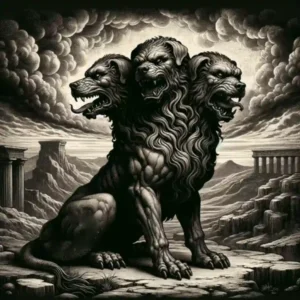
He is usually shown with three heads, a mane of hissing snakes, and a serpent for a tail.
Cerberus’s Core Traits
- Constant vigilance. With three heads, one is always alert.
- Powerful scent tracking. He can detect living breath from a distance.
- A terrifying roar. Loud enough to be heard through Tartarus itself.
- Poisonous saliva. Ancient legend claims the toxic plant aconite grew wherever his drool touched soil.
Only three figures in mythology ever got past him, and none of them actually defeated him in combat. Orpheus lulled him to sleep with music. Aeneas fed him a drugged cake. Heracles simply wrestled him into submission for his twelfth labor.
Cerberus was never killed. He still guards the underworld today.
Meet Fenrir, the Wolf Who Will End the Gods
Fenrir comes from an entirely different mythology, but a similarly monstrous family. He is the son of Loki and the giantess Angrboda, making him brother to the serpent Jormungandr and the goddess Hel.
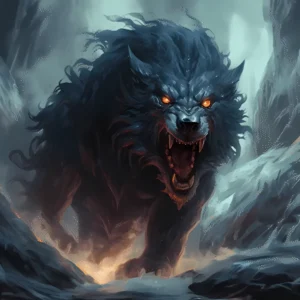
Unlike Cerberus, Fenrir was not born a finished monster. He started as a wolf pup that the Aesir gods tried to raise and control. It did not work.
Why the Gods Feared Him
Fenrir grew at an alarming rate, and the gods grew nervous. They tried to bind him twice with heavy chains.
- The first chain, Leading, he snapped with almost no effort.
- The second chain, Dromi, broke just as easily.
- Only a magical ribbon called Gleipnir, made from impossible ingredients like the sound of a cat’s footsteps and the breath of a fish, finally held him.
To get him to accept the ribbon, the god Tyr placed his own hand inside Fenrir’s mouth as a show of good faith. When Fenrir realized he had been tricked, he bit the hand off completely.
Fenrir’s Core Traits
- Endless growth. His size and strength increase as the world ages, without any known limit.
- Godlike strength. He can shatter chains that no ordinary force could break.
- A consuming bite. Legends describe him as being able to swallow the sun itself during the end of the world.
- Genuine intelligence. Fenrir understood he was being deceived and demanded a price before agreeing to anything.
Chained to a boulder, Fenrir howled for centuries, producing a river of saliva according to legend. His story does not end there, though. At Ragnarok, the final battle of Norse mythology, he breaks free entirely.
What Happens at Ragnarok
This is where Fenrir separates himself from almost every other mythical beast on this site.
He does not stay contained forever. During Ragnarok, Fenrir breaks loose, kills the god Odin, and helps bring about the destruction of the Nine Worlds. He is only stopped when Odin’s son Vidar rips his jaw apart using a magical boot.
Cerberus never gets this kind of moment. He remains a guardian, not a destroyer. That single difference changes the entire comparison.
Cerberus vs. Fenrir: Head to Head
| Category | Cerberus | Fenrir |
| Mythology | Greek | Norse |
| Parents | Typhon and Echidna | Loki and Angrboda |
| Role | Underworld guardian | World ending threat |
| Signature trait | Three heads, never sleeps | Grows without limit |
| Contained by | Never truly defeated | Bound by Gleipnir |
| Ultimate fate | Still guards the underworld | Breaks free and kills a god |
So, Which Beast Reigns Supreme?
It comes down to what kind of monster frightens you more. Cerberus represents something unavoidable and eternal. He cannot be reasoned with, outrun, or worn down, and no hero in mythology ever managed to kill him. That kind of permanence is its own form of terror.
Fenrir represents something worse in a different way. A threat that grows over time and cannot be contained forever. Every chain the gods used eventually failed, and the strongest one only delayed the inevitable. When Fenrir finally breaks free, he does not just escape. He kills the king of the gods.
If the contest is about raw destructive power, Fenrir wins without much argument. Killing Odin is simply a bigger achievement than guarding a gate. But if the contest is about which creature is more impossible to defeat through strength alone, Cerberus edges ahead, since brute force never worked against him either.
Judged purely on mythological consequence, Fenrir reigns supreme. Judged on sheer inescapability, Cerberus remains just as terrifying.
Frequently Asked Questions
Are Cerberus and Fenrir related in any myth?
No. They come from entirely separate mythologies, Greek and Norse, and never appear in the same stories.
Has Fenrir ever actually been killed?
Yes, eventually. During Ragnarok, Odin’s son Vidar kills Fenrir after the wolf kills Odin.
Has Cerberus ever been killed?
No. Every hero who got past him used trickery, sedation, or brute strength to subdue him, but none of them killed him.
Which creature is stronger?
Fenrir is generally considered stronger, since his strength has no known upper limit and he is capable of killing a god.
Are Fenrir and Jormungandr related?
Yes. Fenrir and the serpent Jormungandr are brothers, both children of Loki and Angrboda.
Final Thoughts
Cerberus and Fenrir show two completely different visions of monstrous power. One guards a fixed point forever, immune to force and impossible to escape. The other grows quietly for centuries before erupting into a force that reshapes the world.
Neither is a villain in the simple sense. Both are consequences of larger forces at work, one serving the god of the underworld, the other fulfilling a fate written long before his birth.